iGaming software provider proposals can look comparable until you put them side by side. However, suppliers often price implementation, integrations and support in different ways. As a result, operators may struggle to see which offer provides the best overall fit.
A reliable iGaming proposal comparison starts by putting every response on the same commercial, technical and operational basis. First, normalise the scope and assumptions. Then, verify the evidence behind key claims. Finally, score only the providers that meet the non-negotiable requirements.
Key Takeaways
- 01 Normalise proposalsUse the same scope, assumptions and commercial basis.
- 02 Verify supplier evidenceSeparate claims from what can be checked, tested or referenced.
- 03 Apply mandatory gatesKeep non-viable proposals out of weighted scoring.
- 04 Score viable providersUse one scale, agreed weights and visible evidence status.
Normalise iGaming Software Provider Proposals Before Scoring
Software suppliers write proposals around their own products, terms and pricing structures.
For example, the same activity may appear as implementation, onboarding or professional services.
However, an included feature may still depend on another module or paid service.
Therefore, convert every response into a buyer-controlled format before deciding which software provider is stronger.
Confirm the Delivery Model First
First, confirm that every shortlisted software provider is proposing a comparable delivery model.
If one response is turnkey and another is modular, you still have a solution-selection problem.
Otherwise, compare like with like; our iGaming solution selection guide covers that earlier decision.
Translate Supplier Language Into Your Requirements
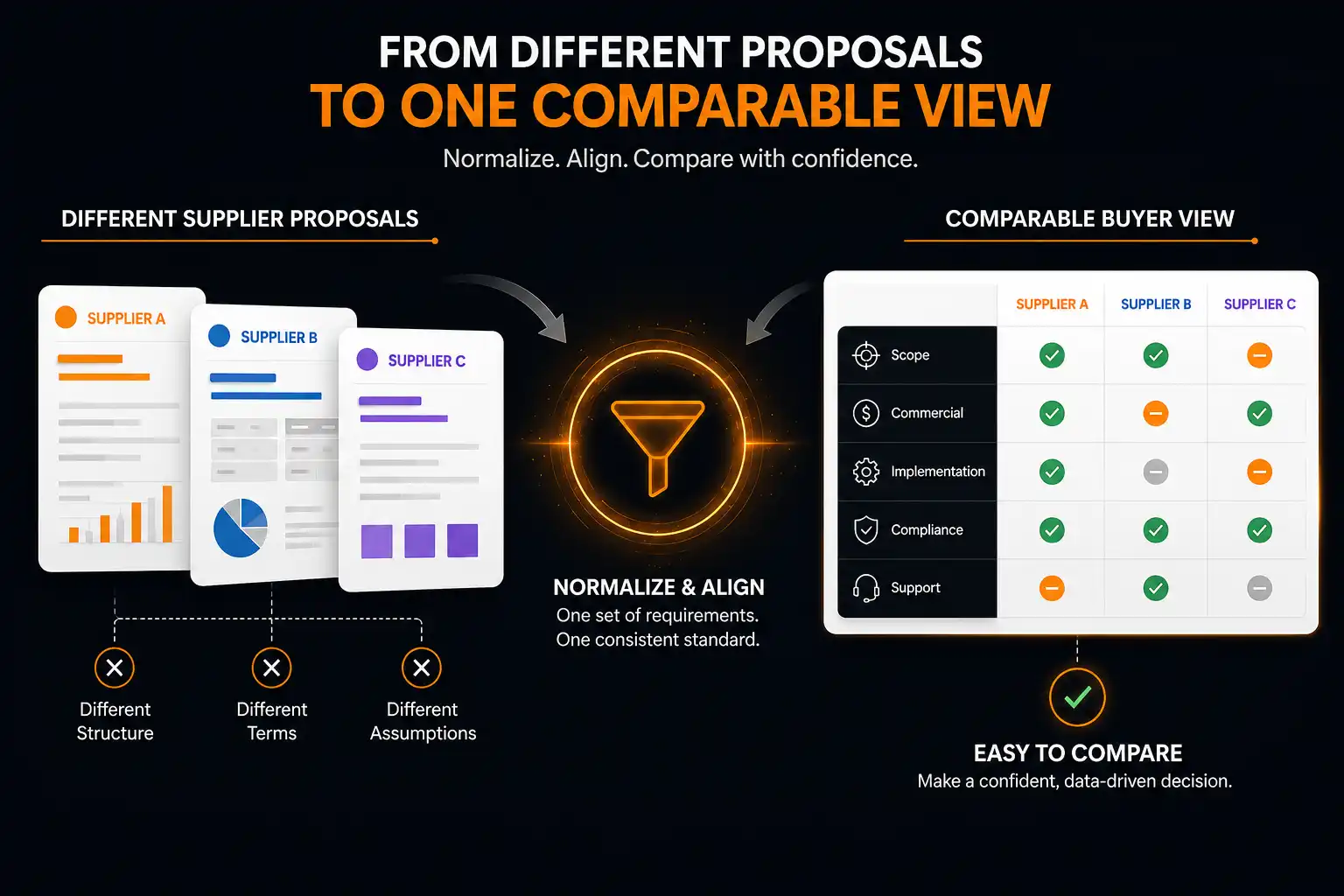
Next, evaluate each proposal or iGaming RFP response against the buyer’s requirements, not the supplier’s headings.
Then, classify each material item as Included, Optional, Assumed, Excluded or Undefined.
This prevents attractive extras from quietly changing the scope.
Keep the Operating Assumptions Consistent
Keep the same brands, markets and operating assumptions across every proposal.
Compare the same casino platform, sportsbook platform or broader stack on one basis.
In addition, separate platform fees from implementation, integrations, third-party services, support upgrades and paid change requests.
| Proposal Area | What Should Be Normalised | Evidence or Clarification |
|---|---|---|
| Core platform scope | Included capabilities and exclusions | Detailed scope schedule |
| Implementation | Delivery activities and responsibilities | Implementation plan |
| Integrations | Connections, dependencies and ownership | Technical scope |
| Operating responsibilities | Supplier, operator and third-party roles | Responsibility matrix |
| Data access | APIs, exports and data structures | Documentation or sample schema |
| Commercial terms | Pricing basis and variable charges | Complete pricing schedule |
| Exit support | Data format and transition support | Exit and migration terms |
The normalisation sheet is not the scorecard.
Instead, it creates a clean comparison layer between raw supplier responses and proposal scoring.
It also exposes gaps that still need clarification.
Verify the Evidence Behind Provider Claims
Once the proposals use the same structure, move to evidence confidence.
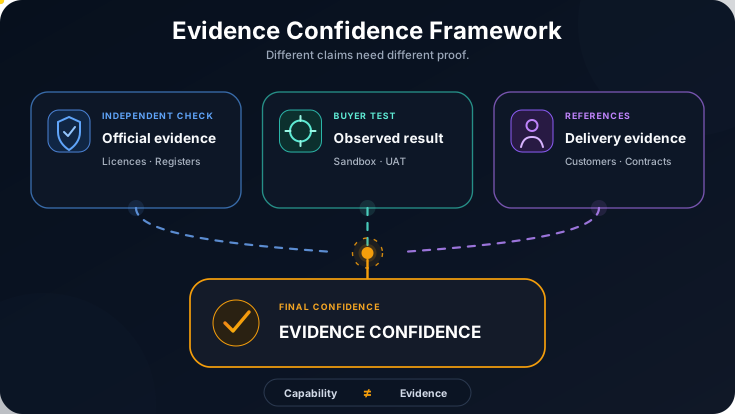
Next, decide which claims you can verify independently, which your team can test and which need references or contractual commitments.
Verify What Can Be Checked Independently
For licences, registrations, authorisations and named certifications, record the legal entity, issuing authority, reference number and covered activities.
Where an official verification route exists, use it.
Instead of relying only on a supplier certificate, confirm the claim at source.
Test What Your Team Can Test
A guided demo proves that a capability exists under supplier-controlled conditions.
Therefore, use sandbox or UAT access where practical.
Inspect exports, permissions, integrations, configuration and failure handling against scenarios your own team defines.
Use References for What Cannot Be Recreated
Some areas are difficult to recreate during procurement, including implementation behaviour, support quality and working relationships.
For those areas, use relevant customer references and clear contractual commitments as supporting evidence.
Keep Performance and Evidence Confidence Separate
A capability can look strong even when the supporting evidence is incomplete.
Therefore, keep the performance score and evidence status separate so an unverified claim does not quietly become a final score.
Compare iGaming Provider Proposals Across Seven Core Criteria
After normalisation and evidence review, compare the shortlisted software providers against the same seven criteria.
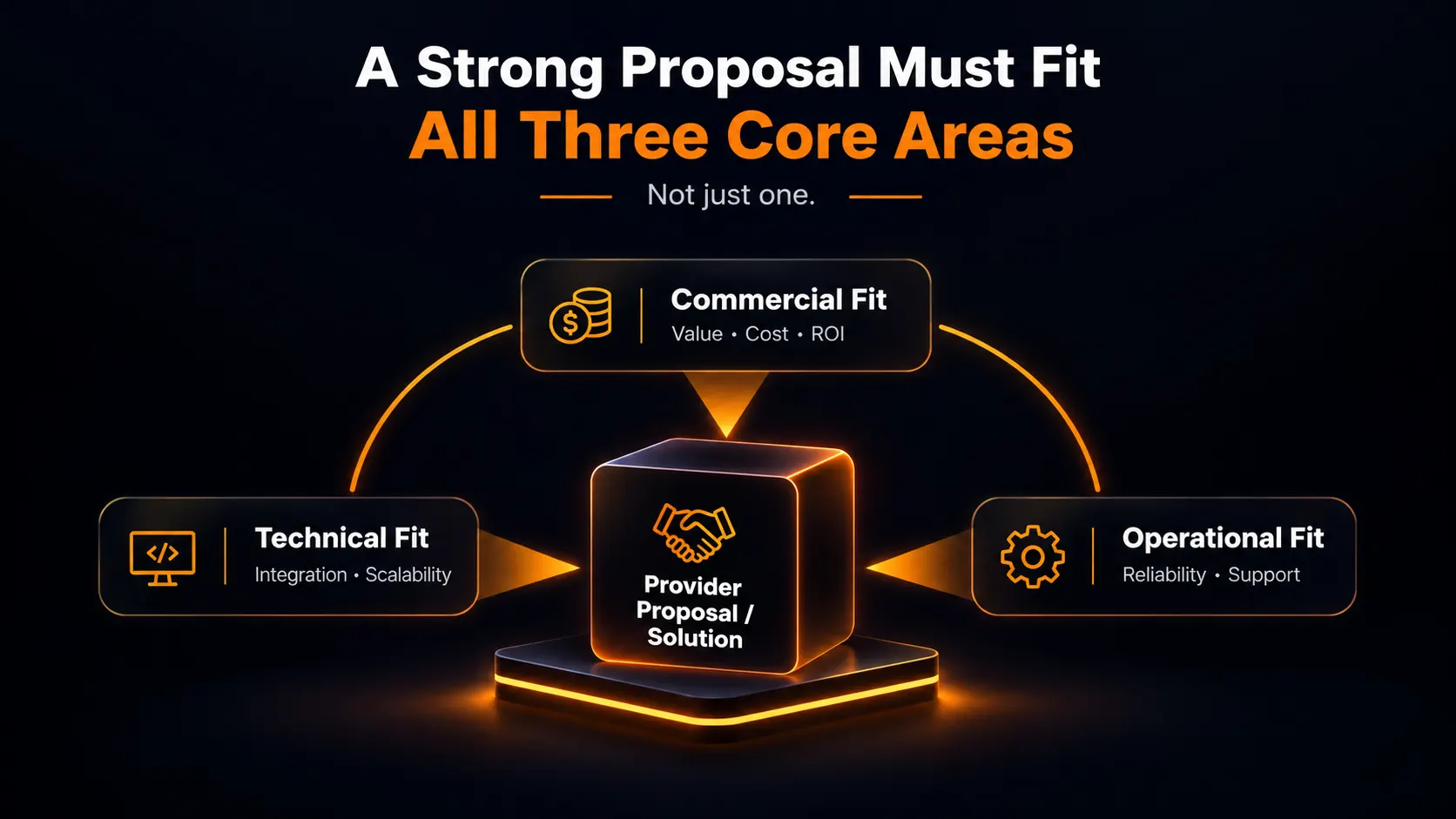
Then, use those criteria to judge commercial, technical and operational credibility rather than rewarding the longest feature list.
1. Scope and Exclusions
Define exactly what the provider commits to deliver.
Then, separate implementation, integrations, configuration, custom development, third-party services, support and post-launch work.
In short, scope answers what you receive, while commercial evaluation answers what you pay for it.
2. Implementation and Delivery Confidence
A launch date only matters when the assumptions behind it are clear.
For lifecycle context, compare this delivery plan with how iGaming technology needs change from launch to migration.
Therefore, review milestones, responsibilities, dependencies, testing and acceptance conditions.
Also, ask how the plan changes when an integration is delayed or a deliverable fails acceptance.
3. Commercial Model
Make every fee, percentage, minimum commitment and variable charge easy to calculate.
Then, confirm revenue definitions, deductions, implementation charges, integration costs, support upgrades and change-request rates.
As a result, the team can model realistic cost scenarios without guessing.
4. Integration and Data
Confirm APIs, authentication, events, permissions, test environments, exports and data structures before commitment.
In addition, define ownership for integration and support, including who builds, monitors and maintains each connection.
5. Compliance, Certification and Security
Tie regulatory claims to the exact company, service and market in scope.
Review compliance and licensing responsibilities before scoring.
For official verification, use the Malta Gaming Authority guidance and the Gambling Commission testing strategy.
6. Support and Incident Response
“24/7 support” is not enough.
Instead, review severity definitions, response commitments and escalation paths.
If the provider also delivers managed services, confirm who owns incidents and third-party coordination.
7. Continuity and Exit
Review exit while the supplier is still competing for the contract.
Then, define data-export rights, formats and transition support.
If replacement is realistic, review the migration path before signing.
Where UK GDPR applies, the ICO contract guidance explains relevant return and deletion obligations.
Proposal Comparison Table
Use one buyer-controlled table to compare shortlisted proposals side by side.
| Comparison Area | Proposal A | Proposal B | Proposal C | Buyer Check |
|---|---|---|---|---|
| Scope | Included | Included with exclusions | Partial | Resolve gaps before scoring |
| Implementation | Defined | Defined with dependencies | Undefined | Compare responsibilities and acceptance |
| Commercial Terms | Itemised | Bundled | Partly undefined | Normalise all charges |
| Integrations | Included | Optional | Per integration | Confirm ownership and fees |
| Evidence | Verified | Mixed | Pending | Keep claim and proof separate |
Weight Proposal Evaluation Criteria Against the Delivery Model
Do not give all seven criteria equal weight by default.
Instead, start with the delivery model.
Then, adjust the emphasis for target markets, internal capability, operating responsibilities and non-negotiable requirements.
- Initial shortlistTypically plan around 4–6 providers for structured comparison.
- Final scored shortlistNarrow to roughly 2–4 viable providers after gates and clarification.
- Evaluation windowAllow about 3–6 weeks; complex multi-market reviews may need 6–10.
| Criterion | White Label | Turnkey | Modular | Specialist | Custom | Hybrid |
|---|---|---|---|---|---|---|
| Scope & exclusions | 20% | 15% | 15% | 15% | 15% | 20% |
| Implementation & delivery | 10% | 15% | 15% | 10% | 25% | 20% |
| Commercial model | 25% | 20% | 10% | 10% | 10% | 10% |
| Integration & data | 10% | 15% | 30% | 35% | 15% | 20% |
| Compliance, certification & security | 20% | 15% | 10% | 10% | 10% | 10% |
| Support & incident response | 10% | 10% | 10% | 10% | 5% | 10% |
| Continuity & exit | 5% | 10% | 10% | 10% | 20% | 10% |
| Total | 100% | 100% | 100% | 100% | 100% | 100% |
White-label and turnkey evaluations usually put more pressure on scope, commercial terms and compliance.
Therefore, scrutinise those areas closely when the supplier coordinates more of the operating environment.
Modular and specialist solutions need stronger integration and data scrutiny.
Meanwhile, custom development and hybrid models increase the importance of delivery, documentation, continuity and long-term control.
If new information genuinely changes the requirement, revise the framework formally.
Then, rescore every supplier against the same updated criteria.
Do not change one provider’s weighting simply because the first result feels uncomfortable.
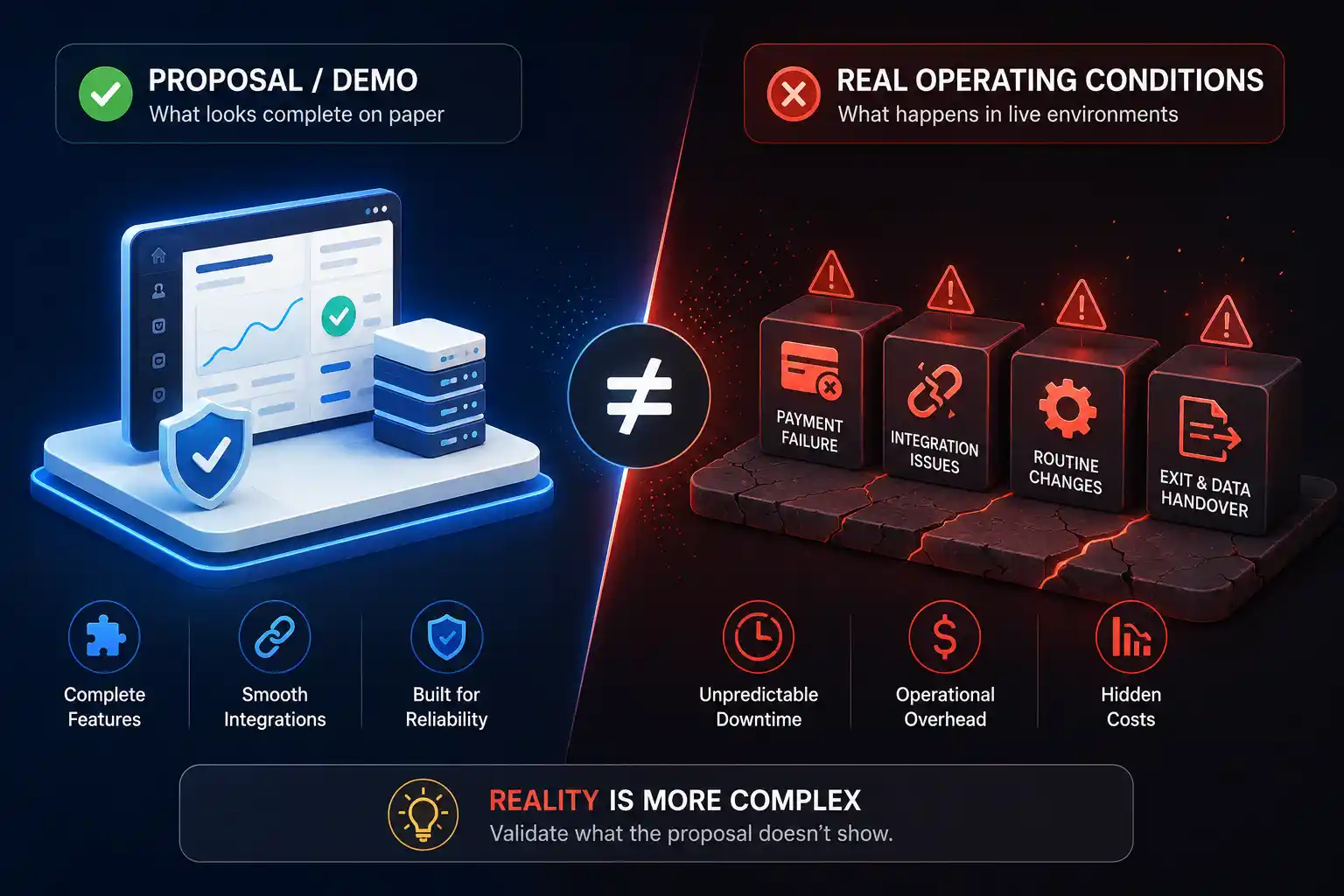
Test Provider Proposals Against Real Operating Conditions
A written provider proposal describes what the supplier intends to deliver.
However, it does not prove how the operation behaves when something fails, changes or needs handover.
Therefore, use structured scenarios to expose those hidden assumptions.
Test Failure Handling
Introduce a payment failure, failed verification request or unavailable third-party service.
Then, check whether the platform makes ownership and the next action clear.
Follow a Routine Change
Trace an ordinary change, such as a campaign rule or reporting export, through request, approval, testing and release.
As a result, you can see how much day-to-day control the operator actually has.
Stress the Delivery Plan
Ask what happens when acceptance testing fails or an external integration is delayed.
Then, check who decides, how the team resequences work and which milestones move.
Walk Through the Exit
Review a sample export or schema and walk through the handover process.
Next, confirm what data is available, what transition support the supplier includes and what would cost extra.
Apply Mandatory Gates Before Proposal Scoring
Some requirements in iGaming software procurement should never be traded away for points elsewhere.
Therefore, define those non-negotiable conditions before calculating proposal scores.
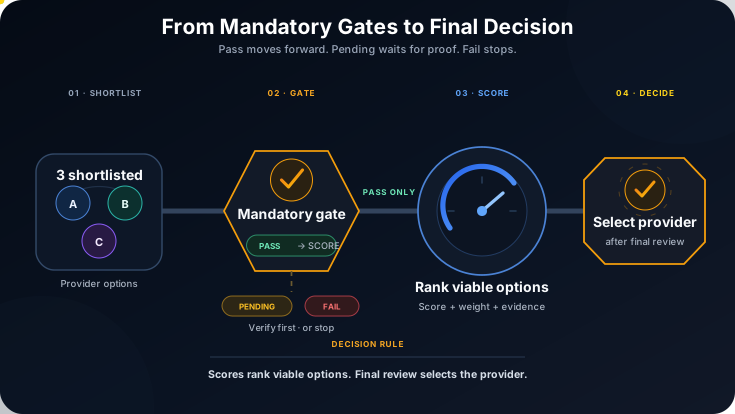
- PassRequirement confirmedThe proposal can continue to weighted evaluation.
- PendingEvidence unresolvedHold the proposal until verification is complete.
- FailRequirement not metDo not let other strengths compensate for the failure.
For example, mandatory gates may cover market eligibility, required authorisations, essential integrations, minimum data access, security requirements or implementation feasibility.
Use One Scoring Scale for Viable Proposals
For proposals that pass the mandatory gates, apply the same five-point scale across every criterion.
This way, different evaluators judge the same level of provider fit.
Weighted points = criterion score ÷ 5 × criterion weight
Example: 4 ÷ 5 × 20 = 16 weighted points.Add the weighted results to create a comparable proposal total.
However, keep evidence confidence visible and do not finalise a score while material verification is still outstanding.
Score Provider Proposals Independently
Before the evaluation meeting, each evaluator should score the same provider proposals independently and record the reasoning.
Then, compare large differences because they can reveal unclear requirements, missing evidence or inconsistent interpretations.
As a result, the final discussion starts from a stronger evidence base.
Challenge the Result Before Selecting the Provider
The weighted proposal score creates an order, but it does not make the procurement decision.
Therefore, recheck the leading proposal against the mandatory gates, unresolved evidence, accepted trade-offs and the reserve supplier before approval.
The final record should capture the preferred and reserve suppliers, gate results, weighted scores, evidence status and outstanding conditions.
It should also explain why the team selected the supplier, not only who finished first.
Conclusion: Choose the Proposal You Can Actually Defend
The strongest iGaming software provider proposal is not always the one with the most features.
It is also not automatically the cheapest or best-presented offer.
Instead, choose the offer that fits the operating model with clear scope, credible evidence, manageable commercial terms and clear responsibilities.
First, normalise the offers and verify the evidence.
Then, protect non-negotiable requirements and score viable proposals on the same basis.
For the next lifecycle decision, see how iGaming technology needs change from launch to migration.
Frequently Asked Questions
First, normalise every proposal into the same structure.
Then, standardise scope, operating assumptions and the commercial basis.
Finally, apply mandatory gates and score only the providers that remain viable using the same criteria, weights and evidence standards.
A strong proposal should define scope, assumptions, implementation responsibilities, commercial terms, integrations, data access, authorisations, support commitments and exit conditions.
If the supplier does not address a material responsibility, keep it undefined.
Wait for a clear answer and supporting evidence before scoring it.
Common exclusions include implementation work, individual integrations, third-party fees, custom development and paid change requests.
Additional testing, higher support tiers and transition assistance may also sit outside the base proposal.
Therefore, price or accept clear exclusions explicitly, while keeping undefined scope open until ownership is clear.
Weighting should reflect the delivery model, target markets, internal capability and non-negotiable requirements.
For example, white-label and turnkey evaluations need stronger scope and commercial scrutiny.
Meanwhile, modular and specialist solutions need more integration and data scrutiny.
You can often verify regulatory authorisations, company registrations and certain certifications through official records.
In addition, your team can test technical capabilities through sandbox access, UAT or controlled demonstrations.
Customer references can then support implementation and service claims.
Yes.
Weighted scoring should compare proposals that already satisfy the mandatory requirements.
Therefore, the team can still reject or hold a provider that fails a critical requirement.
That includes regulatory, technical, security, data or implementation conditions.