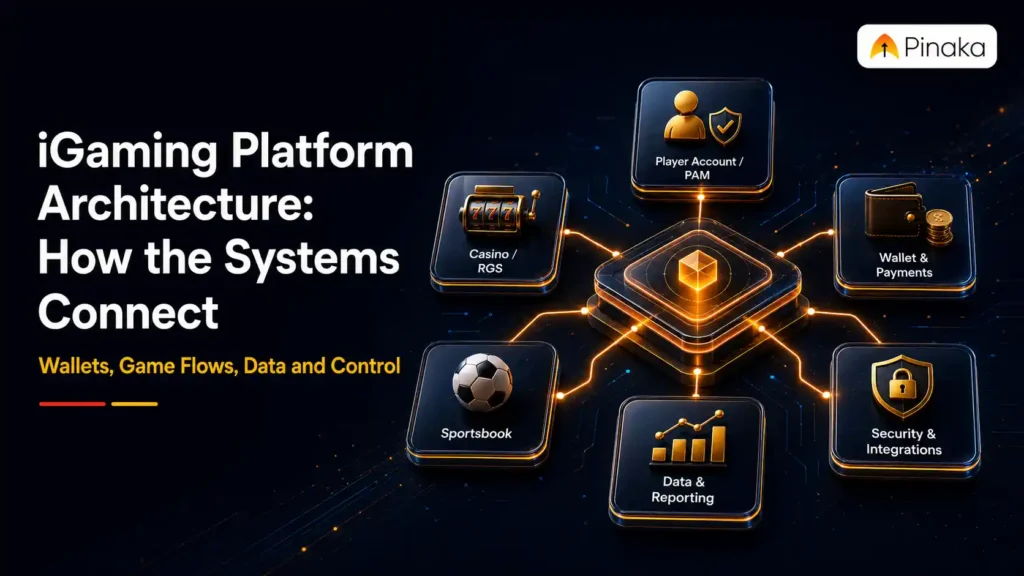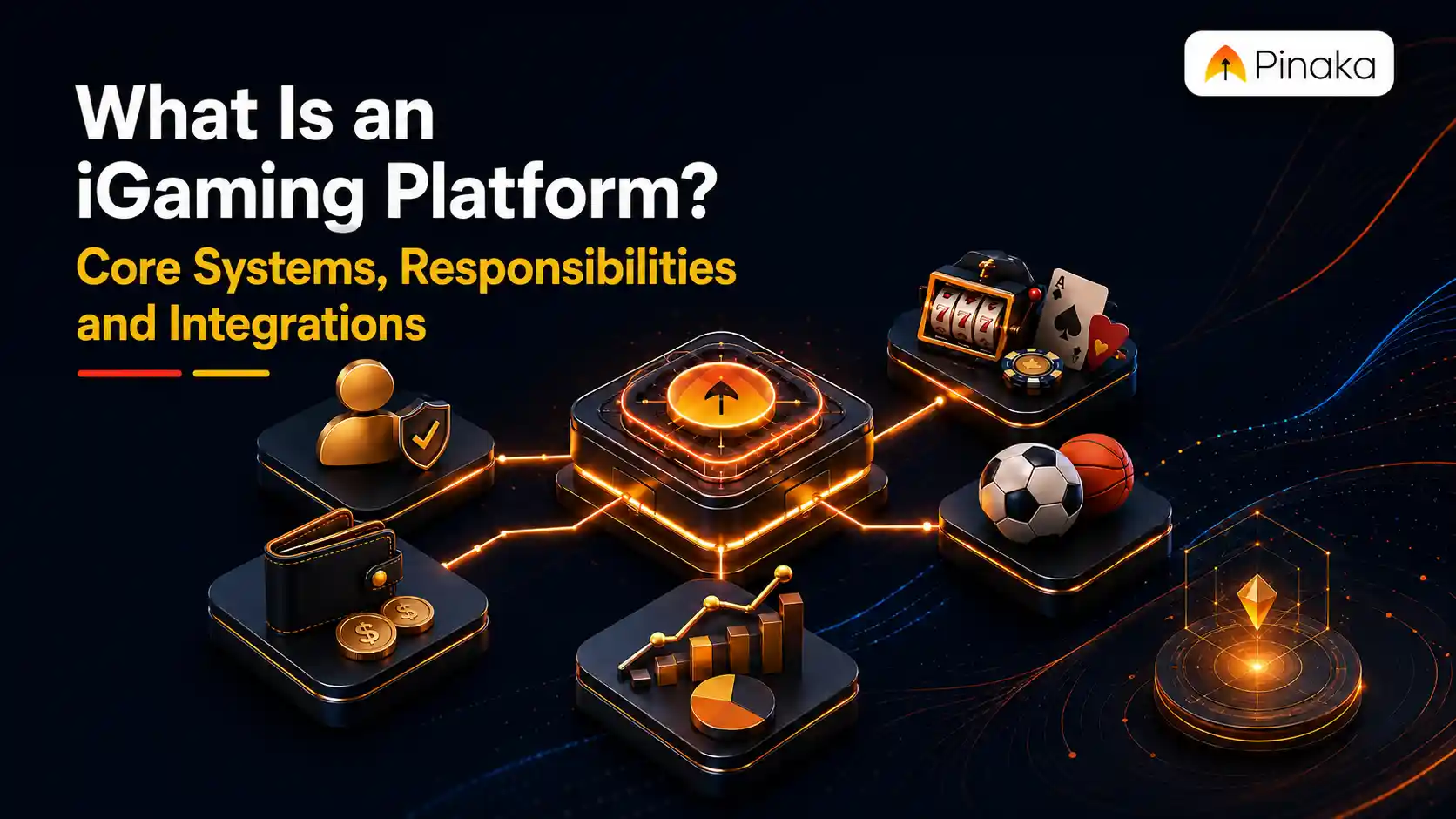
Two suppliers can both offer an “iGaming platform” while selling very different technology. For example, the difference often appears when finance needs a reconciled history, while compliance may need to locate a restriction. Likewise, product teams may need to replace one system without disrupting the rest.
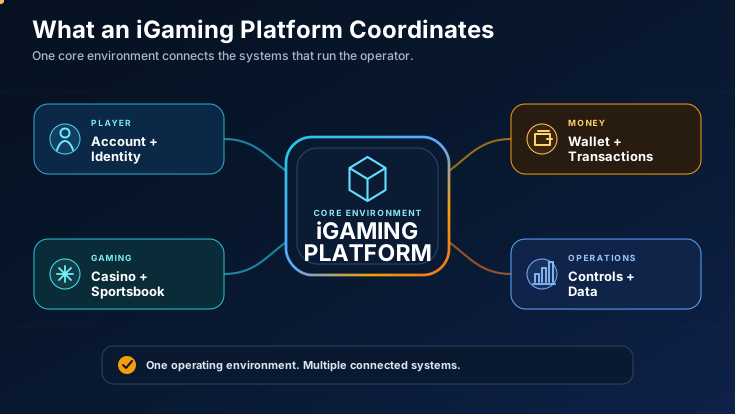
So, what is an iGaming platform? It is the core technology environment used to operate an online gambling business. In practice, it coordinates player accounts, financial activity, gaming products, operator controls and business data. In addition, it connects specialist services such as payments, identity verification, CRM and affiliate management. Therefore, the important question is which system owns each critical function and where the authoritative records live.
Key Takeaways
- 01Platform scope variesDo not assume every supplier means the same thing.
- 02Systems have distinct rolesPAM, wallet, gaming engines and specialists are not interchangeable.
- 03Data authority mattersKnow which record wins when connected systems disagree.
- 04Control beats module countEvaluate access, responsibilities, dependencies and exit.
Core Responsibilities of an iGaming Platform
Different suppliers package their technology differently. However, four responsibilities provide a practical way to understand the role of the platform.
- Player managementMaintain reliable account state, authentication, restrictions, verification status and the rules governing what each player can do.
- Financial coordinationKeep deposits, withdrawals, wagers, winnings and adjustments consistent with the player balance and transaction history.
- Gaming product accessConnect casino, sportsbook and other wagering products with the correct player and financial state.
- Operator controlGive operations, finance, compliance, support, product and technology teams the configuration, permissions and data needed to run the business.
Core Systems and Platform Components
Player Account Management and Identity
Player Account Management, or PAM, manages the player account lifecycle. In practice, it maintains authentication, account state, restrictions, profile information and access permissions.
PAM is central to most iGaming environments, but PAM and platform do not always describe the same scope.
For example, one supplier may include PAM inside a wider stack. By contrast, another may build its platform around a PAM core with specialist products connected around it.
Identity verification shows how this boundary works. For instance, a specialist KYC provider can perform the verification, while the account environment records the outcome and applies the relevant rules.
Wallet, Cashier and Financial Records
The wallet, cashier and payment service provider solve different parts of the same financial journey.
In practice, the wallet or ledger maintains the gambling balance and records changes to it. Meanwhile, the cashier is the player-facing layer used to choose deposit or withdrawal methods. Finally, PSPs execute the external movement of funds.
As a result, an operator can work with several PSPs while still needing one coherent player-level financial record.
Therefore, these requirements do not mean every underlying record must sit in one database. Instead, the operating environment must reconcile and surface consistent financial information across the systems involved.
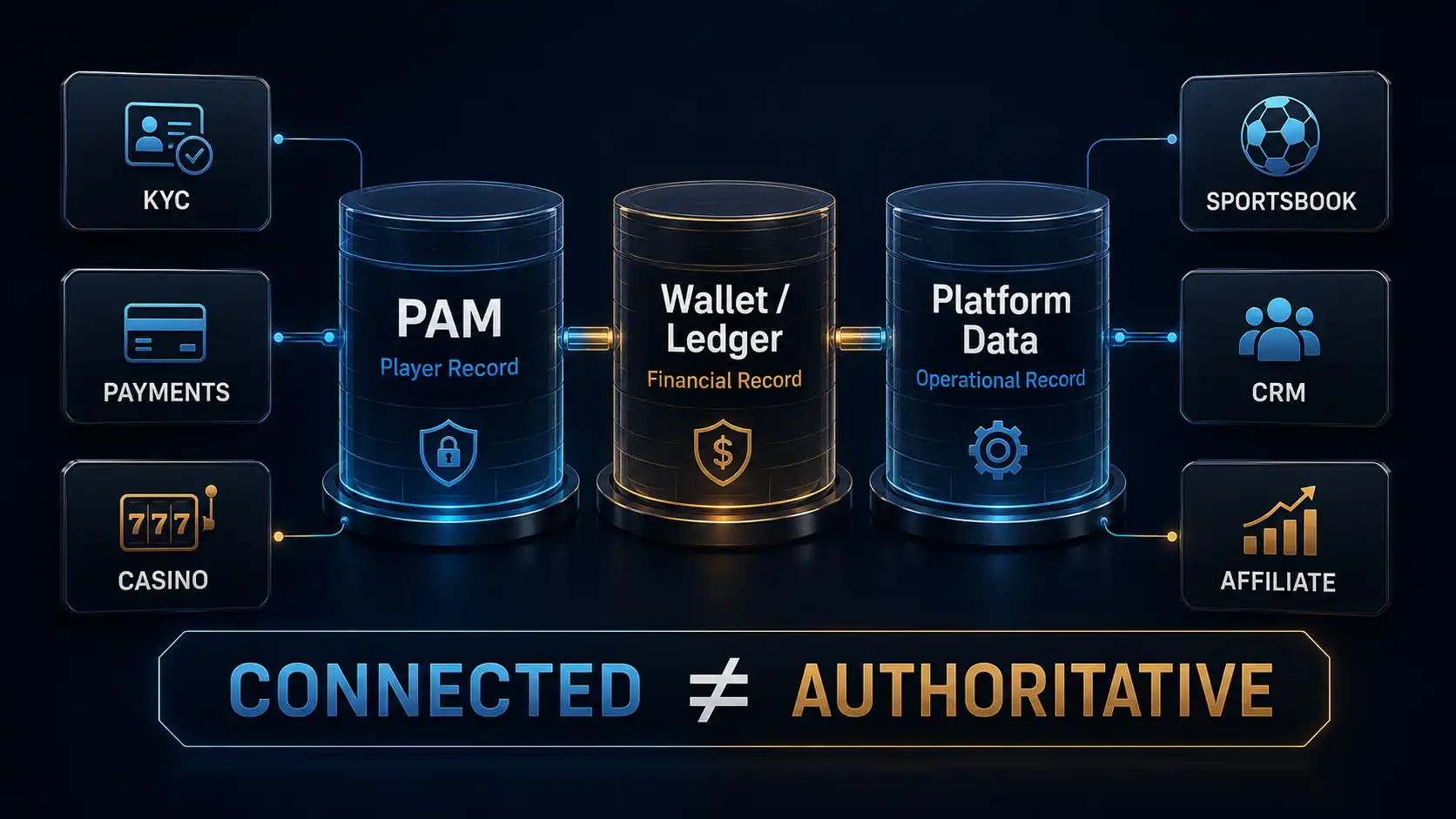
In practice, this is where data authority becomes important. Because the player account, financial ledger and wider platform can hold different records, operators need to know which system is authoritative for each type of information.
Casino and Sportsbook Connections
However, casino and sportsbook products are not automatically the same technology as the core platform. Instead, they sit inside the same player experience while retaining their own responsibilities.
Typically, casino games are produced by studios and delivered through direct integrations or a game aggregation layer. As a result, the platform connects that content with the player account and financial state required to play.
Similarly, a sportsbook engine can manage markets, pricing, bet acceptance and settlement. Next, it exchanges player and wallet information with the wider platform. Therefore, “supports sportsbook” is not enough; operators should establish where sportsbook responsibility begins and ends.
Back Office, Permissions and Operational Data
In practice, the back office is where platform architecture becomes day-to-day operations. Therefore, a strong environment lets each team perform its role without giving every user the same level of access.
- Operations and support: player history, permitted account actions, failed activity and unusual events.
- Finance: balances, transaction records, reconciliation and exports.
- Compliance and risk: evidence showing when controls were triggered and what action followed.
- CRM and commercial: accurate player and behavioural data for permitted lifecycle activity.
- Product and technology: configuration, integrations, data access, monitoring and supplier dependencies.
For that reason, platform requirements should not be defined only by the team negotiating the contract. Otherwise, weaknesses may surface later in departments that were not represented during procurement.
Risk, Limits and Player Protection
Risk and player-protection processes often cross several systems. For example, an identity provider can return a verification result and a fraud system can generate a risk signal. In addition, a player-protection tool can identify a condition requiring action.
Consequently, the platform must apply the relevant decision where the player actually interacts with the product.
A feature labelled “responsible gambling” therefore tells a buyer little by itself. Instead, ask where the limit is stored and enforced. Next, confirm which connected systems can read it and what happens if another product attempts a conflicting action.
CRM, Bonuses and Affiliate Management
Meanwhile, CRM, loyalty, bonuses, affiliate management and advanced analytics sit closer to the commercial and engagement side of the stack.
For example, a CRM can use player and behavioural information for segmentation, automated journeys and campaigns. Likewise, affiliate software can consume acquisition and conversion events while managing attribution, commissions and partner workflows.
Within the Pinaka.games ecosystem, Gamru covers Player Account Management and configurable player-engagement capabilities. Meanwhile, Chanova focuses on CRM and lifecycle orchestration, while AffiBulls handles affiliate management.
Platform Responsibilities and Integrations
Feature lists tend to converge. Responsibility maps expose the differences.
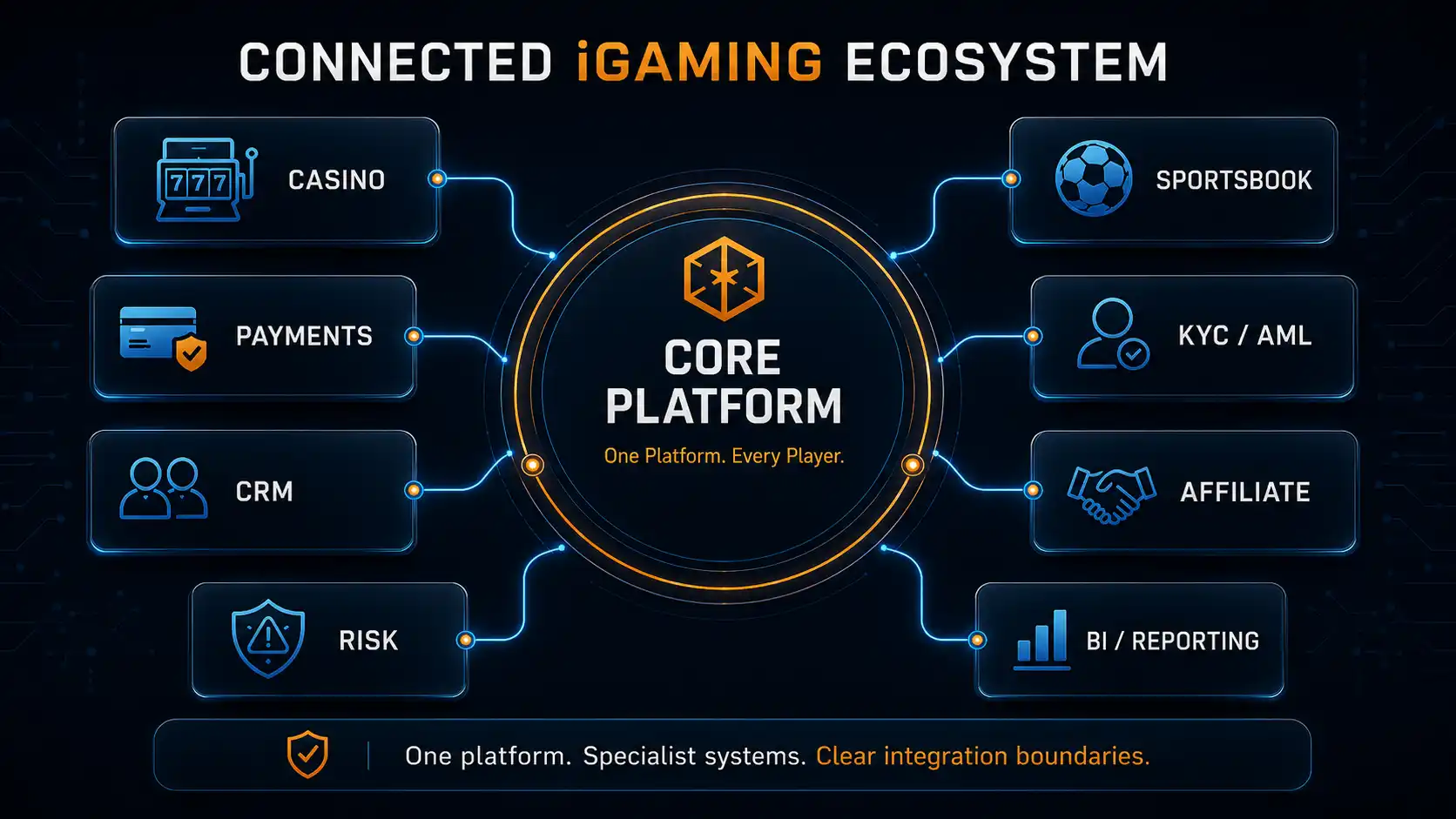
First, the table below maps common responsibility boundaries. Afterward, the ecosystem view shows how specialist systems can connect around a shared platform core.
How Responsibility Boundaries Work
| Capability | Core Platform Responsibility | Specialist or External Role | Question to Ask |
|---|---|---|---|
| Player account / PAM | Maintains account state, access and player controls | KYC and specialist systems supply decisions or data | Which record is authoritative if systems disagree? |
| Wallet / ledger | Maintains gambling balance and financial state | Separate wallet technology may be used | Where is the balance of record and who reconciles it? |
| Payments | Cashier, routing and transaction orchestration | PSPs execute external fund movement | Who owns routing, retries and reconciliation? |
| Casino content | Connects content with player and wallet state | Aggregators and studios provide games | Who owns and maintains the integration? |
| Sportsbook | Connects betting activity with player and financial layers | Betting engine manages markets and settlement | Is it native or separately contracted? |
| Identity / KYC | Stores status and applies account actions | Specialist provider performs verification | Which system triggers the check and acts on the result? |
| Risk / fraud | Applies account-level controls | Specialist products generate signals and alerts | Where is the final decision enforced? |
| CRM | Exposes player and activity data | CRM manages segmentation and lifecycle activity | Is the data current, complete and portable? |
| Affiliate management | Supplies conversion and player events | Specialist system manages attribution and commissions | Which record resolves attribution disputes? |
| Reporting / BI | Provides core operational records and reports | Data platforms extend analysis | Can teams access the underlying data? |
The objective is not to maximise the number of native modules. For example, a broader integrated stack can reduce external integrations. By contrast, a modular stack can give the operator more freedom to replace specialist products.
Either model can work. However, data ownership, integration maintenance and failure responsibility must remain explicit.
Seen as an ecosystem, the goal is not to make every capability native. Instead, the priority is to keep the core relationship, data flow and integration boundary clear.
What Operators Should Verify
Therefore, buyers should confirm whether they can access the information they need and who controls each integration. In addition, they should define what happens if the supplier relationship fails.
How Does an iGaming Platform Work? One Player Journey
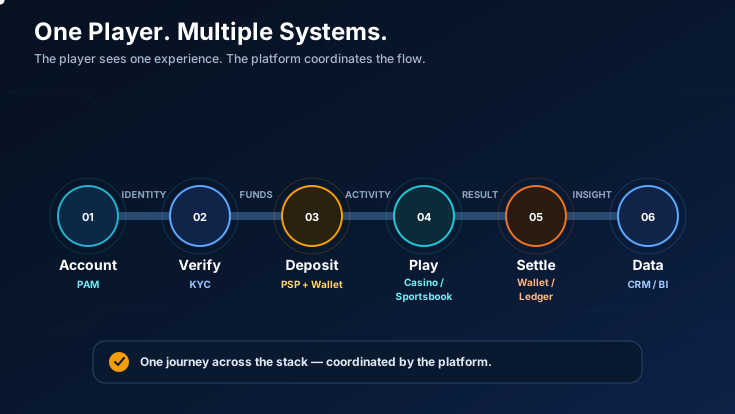
A single player journey shows how several systems work together while the player experiences one product. First, use the visual as the overview; then follow the six steps below for the operational detail.
Account Creation
First, the player registers and PAM establishes the account. As a result, authentication details, account status and applicable restrictions become part of the account state that other systems can reference.
Verification
Next, the identity service performs the relevant checks where verification is required. Then PAM receives the outcome and applies the account state, restriction or permission that follows.
Deposit
After verification, the player chooses a payment method through the cashier. Meanwhile, a PSP processes the external transaction, while the wallet or financial ledger records the resulting state inside the gambling account.
Play or Bet
Next, the player opens a casino game or places a sportsbook bet. The gaming system receives the player and financial information needed to authorise the activity. Then it handles the round or wager within its own domain.
Settlement
Afterward, the relevant financial state is updated once the result is known. Because the gaming engine, platform and wallet can each hold different pieces of the event, consistent identifiers and reconciliation matter.
Reporting and Engagement
Finally, the completed activity becomes available to the systems that need it. Finance can reconcile the activity, while operations can monitor it and compliance can review it. Meanwhile, CRM and affiliate software can use permitted events for their own roles.
Platform, PAM and Connected Gaming Technology
Several terms appear together in supplier conversations even though they describe different responsibilities. Therefore, each term should be evaluated by the role it actually covers.
| Technology | Primary Role | Key Distinction |
|---|---|---|
| iGaming platform | Coordinates the wider operating technology environment | Exact scope varies between providers |
| PAM | Maintains player accounts and account state | Often central to the platform, but not necessarily the entire stack |
| Casino software | Delivers casino gaming functionality and content | Does not automatically manage the wider operation |
| Game aggregator | Connects multiple game suppliers through an integration layer | Provides content access rather than player-account ownership |
| Sportsbook engine | Manages markets, wagers and settlement | Can be native to the platform or separately connected |
| Payment service provider | Executes external deposits and withdrawals | Does not replace the gambling wallet or PAM |
| CRM | Manages segmentation, communication and lifecycle activity | Consumes operational data rather than replacing core records |
Meanwhile, turnkey and white label describe ways technology and operational services can be delivered rather than one specific platform architecture.
Therefore, keep those concepts separate during procurement. Two offers can both use the word “platform” while including very different technology, responsibility and control.
Why Platform Scope Varies Between Providers
There is no single blueprint that every iGaming supplier follows. Instead, providers tend to organise the stack around different technology and commercial boundaries.
- Broad integrated stackKeeps more capabilities within one supplier environment, so PAM, wallet, casino, sportsbook, reporting and engagement modules may sit under the same relationship.
- PAM-centred modular stackKeeps the account core at the centre while specialist casino, sportsbook, payment, CRM, affiliate or analytics products connect around it.
- Vertical-focused platformGoes deeper into casino, sportsbook or another operating area while relying on external systems elsewhere in the stack.
For example, an integrated stack can reduce interfaces and supplier relationships. On the other hand, a modular stack can offer more freedom to replace individual products. However, it also increases integration ownership and data-consistency requirements.
Practical Scale Markers
These figures are planning markers rather than universal guarantees. They show why certification scope, integration ownership and market coverage should be checked explicitly during platform evaluation.
- Weeks → monthsCertification planning
Independent certification is typically planned in weeks to a few months per jurisdiction. iGamingHub notes that lab queues, evidence quality and remediation can extend the schedule.
- 8–10Integration categories
A representative modular stack can span roughly 8–10 integration categories across payments, KYC, gaming, CRM, affiliate, risk and reporting. Use this as a planning range, not an industry average.
- 47Jurisdictions
Testing coverage is market-specific. eCOGRA states that it is accredited in 47 jurisdictions and counting, so operators should verify exact market coverage rather than rely on a generic “multi-jurisdiction” claim.
Questions to Answer Before Evaluating a Platform Provider
Once the platform boundary is understood, supplier evaluation becomes much more meaningful. From there, operators can compare responsibility, access and control rather than relying on feature count.
Which Systems Hold the Authoritative Records?
First, identify where player state, balances, transaction history and other critical records originate. When the same information exists in several systems, define which record wins if those systems disagree.
Which Capabilities Are Native and Which Are Integrated?
Next, separate native capabilities from integrated ones because this exposes dependencies a feature list can hide. For example, payments, KYC, CRM or sportsbook features may appear in a demo. However, they can still rely on separate technologies, suppliers or contracts.
Can the Operator Access and Export the Data It Needs?
In addition, finance, compliance, reporting and technology teams should be able to retrieve the underlying information they depend on. Otherwise, they may become dependent on supplier dashboards rather than the underlying records.
Regulatory context: LCCP 1.1.2 requires relevant contracted third parties to provide information the licensee reasonably needs to meet its obligations to the Gambling Commission.What Can the Operator Control Directly?
Then establish which settings, permissions, products, player actions and integrations can be managed internally. By contrast, identify which changes still require supplier intervention.
Who Owns Failures, Changes and Exit?
Finally, define responsibility for failure, change and exit. Over time, APIs change, providers fail, transaction states disagree and commercial relationships end. Therefore, data access, integration maintenance and transition responsibilities should be clear before those situations occur.
As a result, these questions move the comparison beyond feature count. More importantly, they reveal the responsibilities, dependencies and control model behind a platform offer.
Conclusion
Overall, an iGaming platform is more than a collection of modules. Instead, it is the operating environment that keeps player accounts, financial activity, gaming products, controls and business data aligned while specialist systems connect around them.
Because platform scope varies between providers, operators should not judge an offer by feature count alone.
Therefore, define the technology boundary before choosing a provider.
First, confirm which systems hold the authoritative records and who owns each integration. Next, verify what data your teams can access and how responsibility changes when something fails or needs to be replaced.
Ultimately, a strong platform gives the operator clear ownership, dependable data and enough control to evolve the stack as the business grows .
Frequently Asked Questions
PAM is normally a core part of an iGaming platform, but the terms do not always describe the same scope.
In practice, PAM focuses on the player account and account state. In addition, a wider platform can connect wallet technology, gaming products, payments, reporting, CRM and risk tools.
Casino content is generally supplied by game studios and reaches the operator through direct integrations or a game aggregator.
Meanwhile, the platform connects that content with the player account, wallet and wider operating environment. Therefore, it does not necessarily produce the games itself.
Typically, the platform manages cashier interaction, transaction state and wallet integration. Meanwhile, payment service providers execute the external movement of funds. As a result, the operator still needs one consistent player-level financial record across those payment methods.
Yes.
For example, a multi-vertical platform can support casino and sportsbook within the same player and financial environment. However, the sportsbook engine may belong to the same supplier stack or operate as a separate product connected to PAM and wallet services.
No. An iGaming platform is the underlying technology environment. By contrast, white label describes a commercial and operational delivery arrangement built around technology and services. Therefore, different white-label offers can use platforms with very different scopes.
No.
A platform is technology, while a gambling licence is regulatory authorisation. For example, some commercial arrangements may provide technology within a broader licensed operating structure where permitted. By contrast, other models require the operator to obtain its own relevant licences.