Choosing the right iGaming solution is not about finding the platform with the longest feature list. It is about matching technology to the business you are actually building.
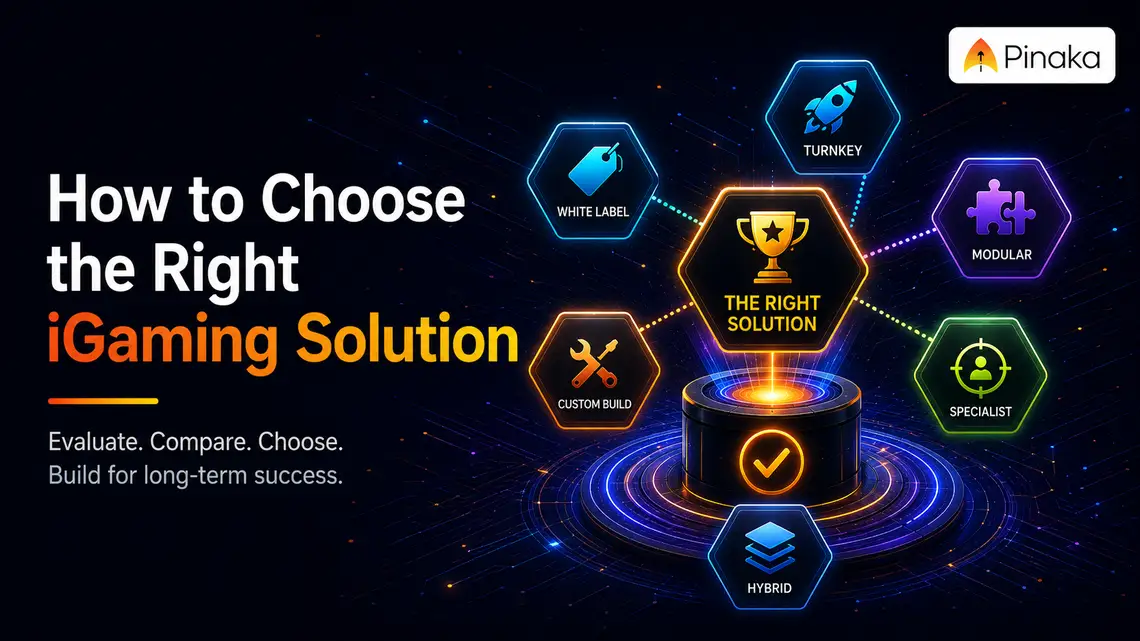
The market, product mix, operating model, internal team, required control, budget and next realistic growth stage all change the answer. White label, turnkey, modular, specialist, custom and hybrid models can each fit different situations, so define the requirement before comparing providers.
Key Takeaways
Use these seven decisions to narrow the field before provider comparison begins. By shortlist stage, the business should be comparing one or two solution routes against the same commercial, technical and operating requirements.
Start With the Business Problem
Before choosing an iGaming platform, define the change the business is trying to make. A new operation may need a complete route to market. An established operator may instead be entering a jurisdiction, adding a product vertical, replacing restrictive core technology or fixing one weak part of an otherwise suitable stack.
Those situations should not produce the same procurement process. Replacing the core brings migration, data portability and architectural control into scope. A working core may only need stronger CRM, affiliate management, reporting or aggregation.
Why Feature Lists Can Mislead
A product demonstration shows what the technology can do. It does not prove that the delivery model fits the way the operator needs to work. The useful comparison is practical control: what the team can configure, release, export and integrate independently, not how many boxes receive a tick.
Turn the Problem Into a Clear Requirement
A useful requirement describes an operating outcome instead of simply listing functionality.
We need to launch a licensed sportsbook in one target market, keep trading managed initially, retain direct access to player and transaction data, and support an internal trading team later without replacing the core platform.
That statement already identifies the market, product, responsibility split, data requirement and next credible change. A strong problem statement should do the same without trying to predict every future feature.
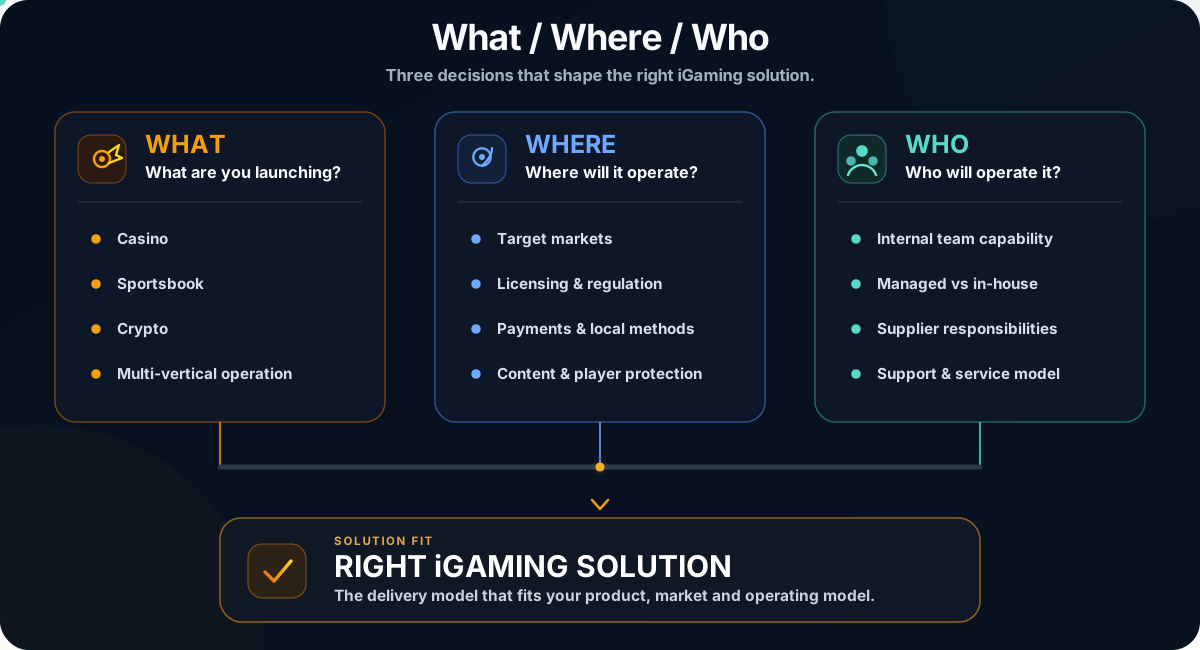
Define What You Are Launching, Where and How You Will Operate
Product, market and operating model shape most iGaming software requirements. The product determines systems and workflows. The jurisdiction adds regulatory and commercial conditions, while the operating model decides which responsibilities stay in-house.
Product Requirements Change the Operating Model
01Casino Requirements
Casino evaluation should cover content access, aggregation or direct studio integrations, market availability and promotional mechanics. Then verify that those mechanics work across the platform, aggregator and game suppliers. A feature only matters if it works with the required content in each target market.
02Sportsbook Requirements
Sportsbook selection should begin with the trading model: in-house, managed or hybrid. That choice affects risk workflows, staffing, data feeds and how capabilities such as cash out, bet builders, in-play markets and promotions are operated in practice.
03Crypto Requirements
Crypto operations add wallet, custody, key control, transaction monitoring and fiat on-ramp or off-ramp dependencies. Decide where those responsibilities sit early because wallet architecture and transaction ownership can influence the wider platform design.
04Multi-Vertical Operations
A unified account experience does not automatically mean one system owns the wallet, ledger, KYC decision, limits or exclusions. Test cross-product scenarios to understand how account state, balances, consent and player-protection rules behave across every vertical.
Confirm Market and Regulatory Readiness
The target jurisdiction can remove unsuitable technology before detailed comparison begins. Confirm which entity holds the relevant licence, what it covers, and which components need testing, certification, reporting or regulatory approval.
Market readiness also includes payments, player protection, identity verification, content availability and operating procedures. Self-exclusion is a good example. Great Britain uses GAMSTOP and the Netherlands uses CRUKS. Sweden uses Spelpaus, while Denmark uses ROFUS. The purpose is similar; the implementation is not.
Define What “Market Ready” Actually Means
- 01Approved & testedApproved and tested configuration
- 02Live deploymentExisting live deployment
- 03Regulatory integrationsRequired regulatory integrations completed
- 04Awaiting approvalTechnically compatible but awaiting approval
- 05PlannedFunctionality not yet deployed
“Market ready” is not one state. Ask the supplier which level applies to each jurisdiction in scope.
Match the Solution to the Team That Will Operate It
Technology selection depends on how much of the operation the internal team intends to manage. Some operators want direct control over configuration, CRM, payments, support and technical incidents; others deliberately outsource selected responsibilities.
Both approaches can work. Problems appear when the delivery model assumes an internal capability the organisation does not actually have.
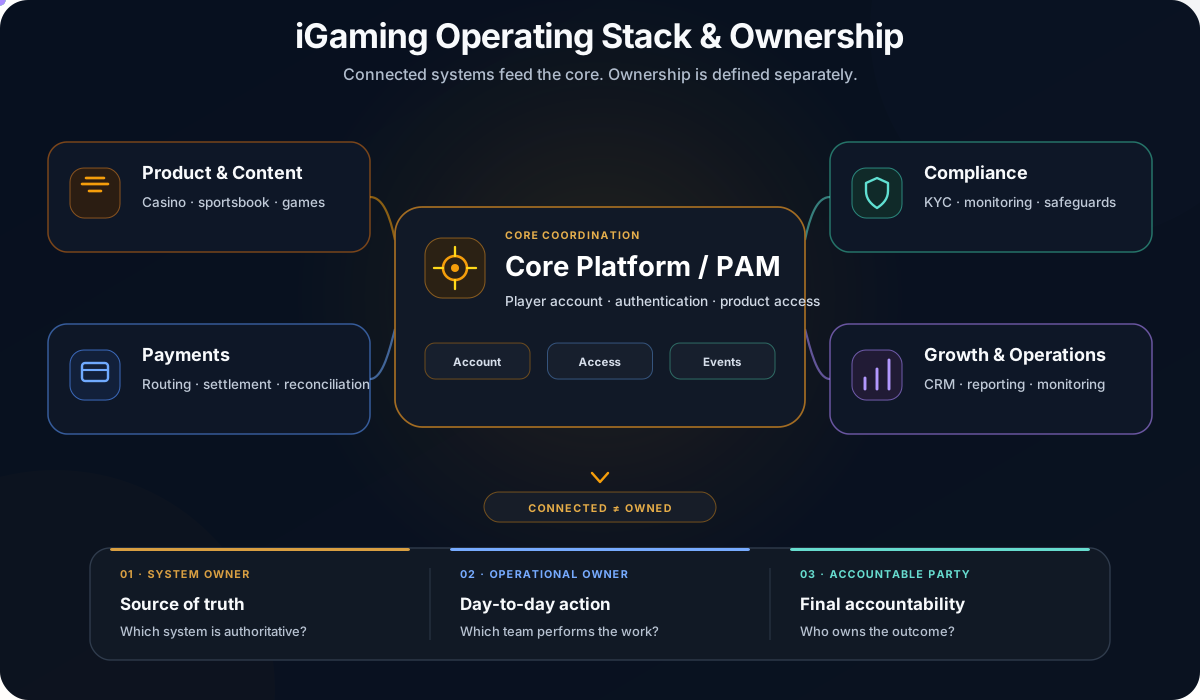
Separate System, Operational and Accountable Ownership
- System owner
Which system holds the authoritative record?
- Operational owner
Which team performs the day-to-day task?
- Accountable party
Who approves the outcome or retains final accountability?
Plan Around the Team You Actually Have
A modular platform can offer substantial control, but that control may require integration ownership, payments expertise and technical product management. If those roles do not exist and are not funded, the organisation may not be ready to operate that model.
Set a Realistic Launch Scope and Timeline
Time to market matters when a real commercial event sits behind the date, such as a sports season, licence window, funding commitment or planned market entry. A general ambition to launch “as quickly as possible” should not carry the same weight.
Understand the Real Critical Path
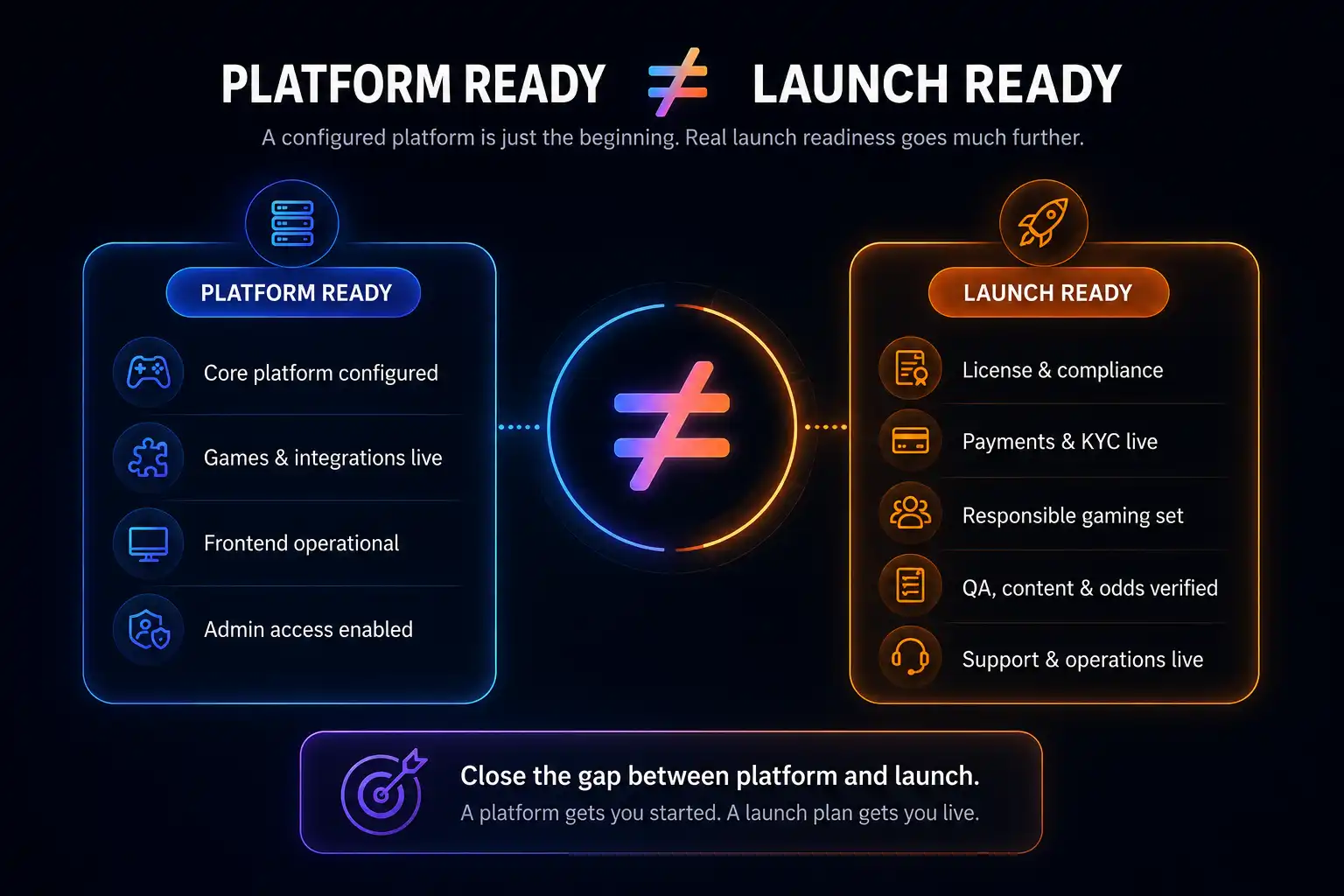
The platform is only one workstream. Licensing, payment onboarding, testing, content approvals, KYC, CRM, reporting, migration, recruitment, training and production readiness can all affect the final date. Supplier timelines therefore need their assumptions, not only an end date.
Use Realistic Planning Ranges
For early planning, common 2026 benchmarks place white label launches at about 2 to 4 weeks, turnkey at 1 to 3 months, and custom development at 6 to 18 months.
Assumptions: one initial brand and market, standard integrations, no complex legacy migration, and required approvals moving on schedule. Supplier scope, licensing and certification can move these ranges materially.
Define the Minimum Launch Scope
A first release may need one approved market, one brand, a defined payment set, appropriate content, complete player-protection controls, core reporting and tested support procedures. Secondary features can follow when they do not affect compliance or operational readiness.
The strongest launch plan is the point at which platform, integrations, people and procedures become ready together.
Map the Technology Stack and Ownership Boundaries
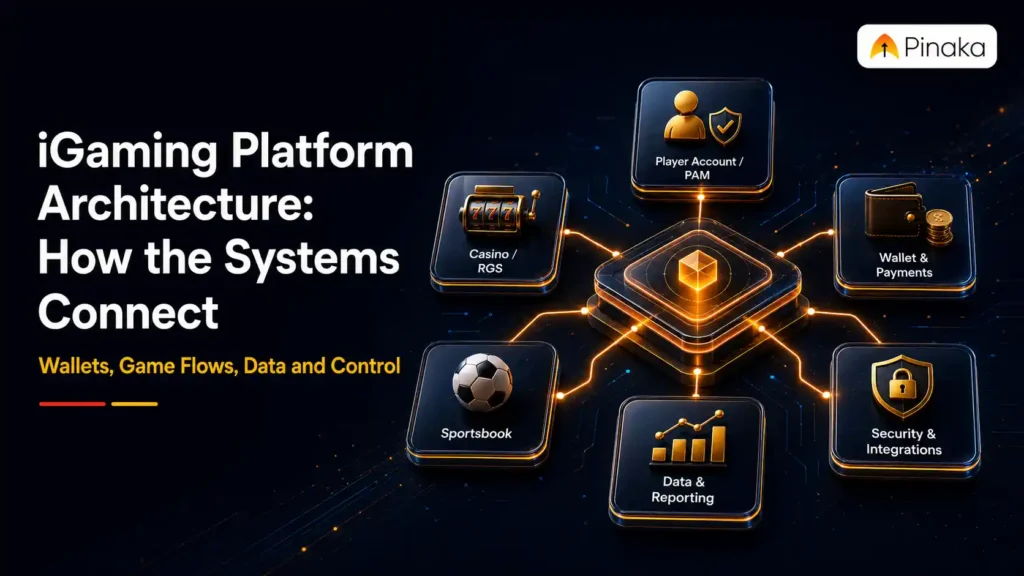
An iGaming operation is a connected environment of core platforms, specialist tools, infrastructure, third-party services and operating teams. The procurement question is not only whether each component exists, but how those components interact and who owns each process.
Understand the System Boundaries
A PAM may display a balance without owning the financial ledger; a KYC service may return a result while the operator retains the final decision. A capability appearing inside one interface does not automatically make that system authoritative.
Payments need more than a supported-method list. Verify routing, withdrawals, settlement, failed transactions and reconciliation, including who handles exceptions when platform and provider records disagree.
CRM, Reporting and Continuity
CRM, affiliates and reporting depend on reliable two-way data. Dashboards show information, but APIs, exports and warehouse feeds determine how independently the operator can retrieve, combine and audit it.
Security and continuity also need explicit ownership for privileged access, monitoring, vulnerability response, backups, recovery and incident communication.
Decide How Much Control the Business Actually Needs
Greater flexibility can be valuable, but it creates implementation work, technical responsibility and cost. The objective is not maximum control; it is the amount of control the organisation will realistically use.
- 01Experience and productBrand, journeys and day-to-day configuration
- 02Technology and integrationsAPIs, logs, third-party systems and data access
- 03Release and operating controlWho can change, approve and deploy on the required timeline
Configuration and Release Control
A platform may be highly configurable while routine changes still require supplier intervention. Ask what product, marketing and operations teams can change during a normal working day without opening a support request, and who decides when those changes reach production.
Use Customisation Deliberately
Custom workflows should support a validated business need. Engineering may need APIs, logs, staging environments and test data without needing source-code ownership. Classify each control requirement as essential for launch, important for the next credible stage or unnecessary for the foreseeable future.
Evaluate Integrations Before Trusting the Logo Wall
An integration logo proves compatibility, not production quality. Before a connection becomes operationally critical, verify documentation, delivery behaviour, testing, security, monitoring and change management.
- DocumentationInterfaces, events, fields and limits
- DeliveryRetries, replay and recovery
- TestingSandbox or UAT environment
- OperationsMonitoring, permissions and change notice
Watch for Silent Integration Failure
If player events stop reaching CRM, both systems may continue looking healthy while campaigns operate on stale information. Confirm how missing events are detected, whether they can be replayed and what the internal team can diagnose without supplier support.
- 01Event createdPlatform / PAM
- 02API / WebhookDelivery layer
- 03Silent failure?Detect · retry · replay
- 04Recovered stateCRM / BI / specialist tool
Define the System of Record
For every critical record, including the player account, ledger, KYC result, restriction, consent, attribution and payment status, define one accepted source of truth. Document the receiving systems, update frequency, failure detection and reconciliation method before launch.
Check Data Access and Exit Risk Before Signing
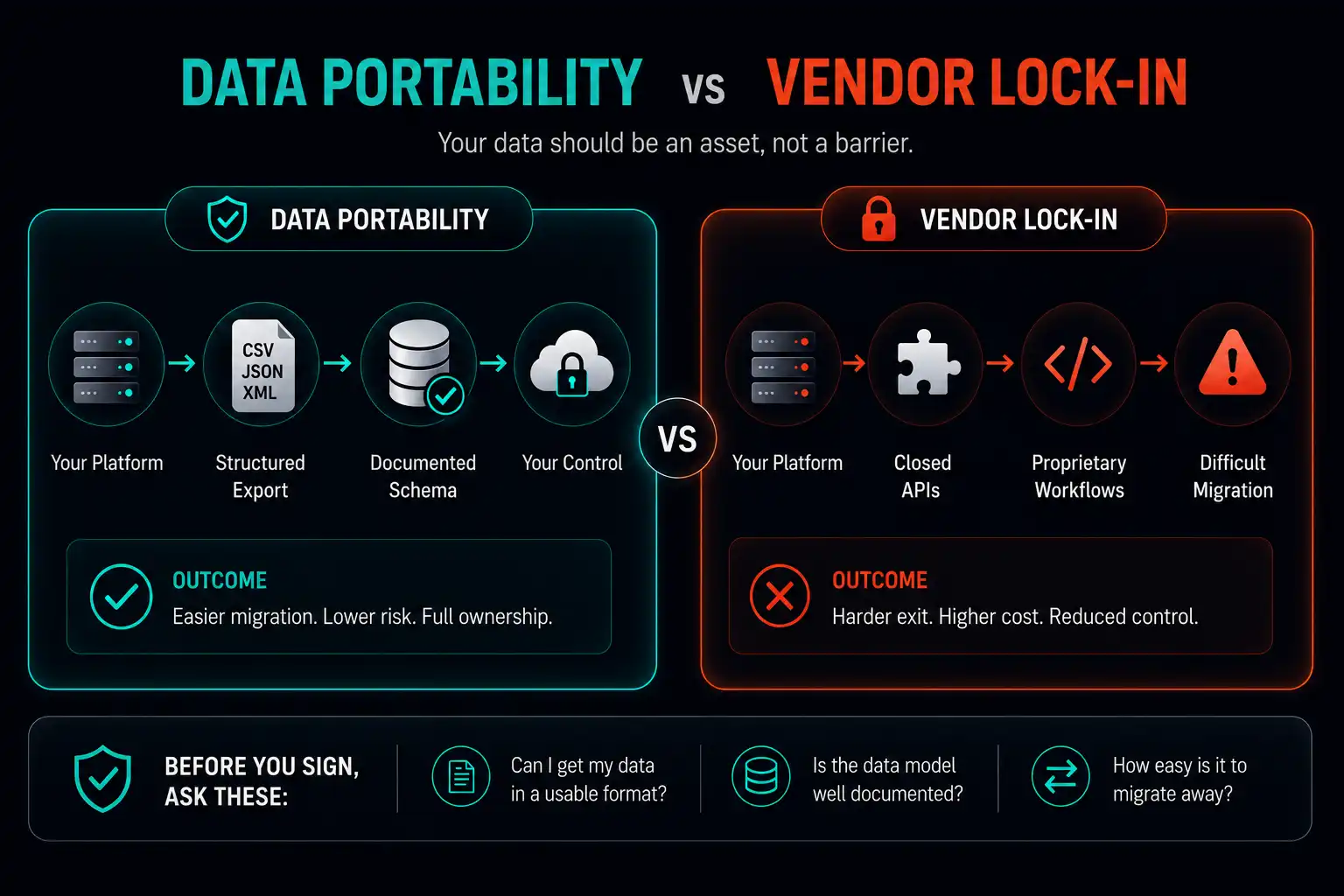
The phrase data ownership is too broad for procurement. The practical questions are access, export rights, portability, retention and migration support. If the relationship ends, the operator may need player, transaction, ledger, consent, compliance, affiliate, configuration and audit records.
An Export Is Not Automatically Migration-Ready
A database dump without a schema, field definitions or relationship mapping may technically satisfy an export request while still being difficult to migrate. Review an anonymised sample export or documented schema during evaluation, not at exit.
Applicable processor contracts under EU GDPR Article 28 address return or deletion of personal data when processing ends, subject to retention requirements. They do not automatically guarantee a continuous export, usable schema or migration assistance.
Vendor Lock-In Usually Develops Gradually
Lock-in tends to build through limited APIs, proprietary workflows, supplier-controlled relationships, undocumented customisations and data that has never been reconciled independently. Agree exit conditions while the operator still has negotiating leverage.
Compare Total Cost and Plan for Realistic Growth
Compare Total Cost of Ownership, Not the Starting Price
The platform fee is only one part of the commercial decision. Different delivery models move cost between the main supplier, third parties and the operator’s internal organisation.
- White label $22,000 to $55,000 upfront; often with recurring platform or revenue-share charges.
- Turnkey $110,000 to $550,000+ depending on scope, integrations, licensing responsibilities and implementation depth.
- Custom development $275,000+ before ongoing product, infrastructure, security and maintenance costs.
Planning assumption: these are indicative 2026 setup ranges, not supplier quotes. Compare providers using the same brand, market, integration and operating assumptions. Exclude licensing, marketing, working capital and recurring third-party fees unless every quote includes them.
| Cost Category | What Should Be Included |
|---|---|
| Implementation | Setup, configuration, testing, frontend work and migration |
| Platform & third parties | Licence or revenue-share fees, hosting, content, payments and verification |
| Integration & compliance | Development, certification, market work and ongoing change |
| Internal operations | Product, engineering, compliance, finance, CRM, support and supplier coordination |
| Change & exit | Support requests, exports, notice periods, migration help and continued access |
Build one total-cost model that includes implementation, recurring commercial charges, third-party services, internal staffing and ordinary change. Model at least a launch case, expected case and pressure case so the team can see how the commercial structure behaves as activity grows.
- Launch case
Minimum approved operating scope
- Expected case
Growth already supported by budget and roadmap
- Pressure case
Higher activity, more integrations or greater support demand
Choose for the Next Realistic Stage of Growth
Technology should solve day-one requirements without being over-engineered for every scenario the business can imagine. Plan around the next change that already has evidence behind it. That evidence might be approved budget, a submitted licence application, a funded roadmap or performance data supporting expansion.
- New brand or marketProve permissions, reporting, payments, compliance and local content can scale cleanly.
- New vertical or specialist productProve the new component can connect without replacing the core or creating conflicting systems of record.
- Higher activity or insourcingProve infrastructure, support, access, responsibility and pricing can change predictably.
The right solution should solve the current constraint and preserve a credible route forward. It does not need to support every hypothetical future.
Compare the Main iGaming Solution Models
Once requirements, operating responsibility, control, integrations, data and commercial structure are clear, the six main delivery models become much easier to compare.
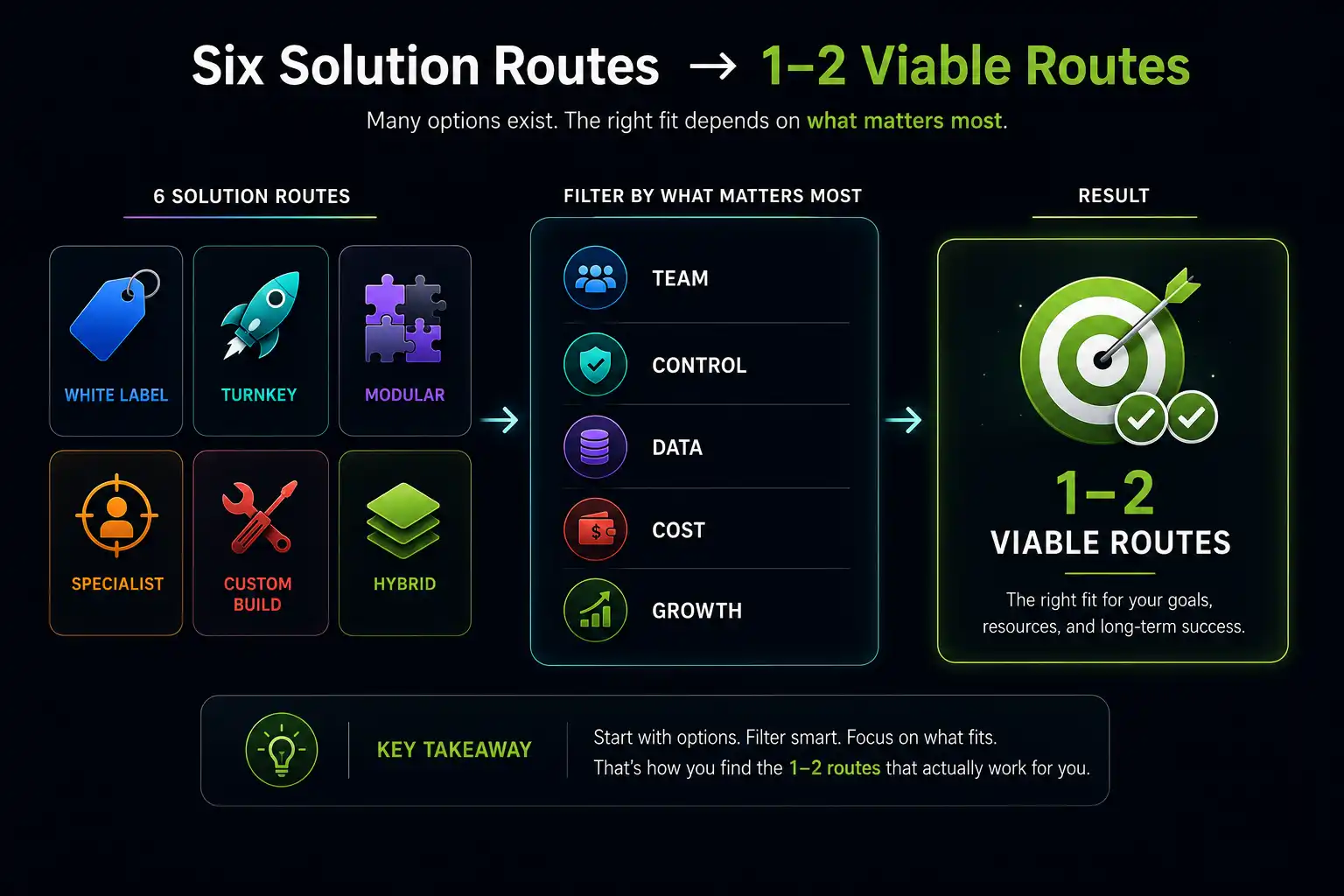
| Solution Model | Typically Fits | Main Advantage | Main Trade-Off |
|---|---|---|---|
| White label | Lean teams needing extensive support | Lower coordination requirement | Greater provider dependence |
| Turnkey | Operators wanting coordinated delivery | Integrated implementation path | Established architecture boundaries |
| Modular platform | Teams needing stronger stack and data control | Component flexibility | Greater technical ownership |
| Specialist product | One important gap in a working stack | Targeted improvement | Additional supplier and integration |
| Custom development | Validated requirement unsupported by products | Differentiation | Delivery and maintenance responsibility |
| Hybrid model | Different components need different approaches | Better fit by component | More system boundaries |
Open the Details Only for Models Still in Scope
01White Label
White label generally suits businesses that need substantial provider support and have limited internal technical capacity. The shorter path to operation usually comes with greater provider dependence. Make licensing, data access, configuration rights and exit terms explicit before signing.
02Turnkey
Turnkey suits operators that want coordinated platform delivery without independently assembling every component. The advantage is an integrated implementation path; the trade-off is working within an established architecture. Always confirm the exact product and service scope because “turnkey” is not standardised.
03Modular Platform
A modular platform suits operators that need stronger control over components, external suppliers and operational data. Components can be added or replaced more independently, but the business takes on greater responsibility for integrations, monitoring, release management and incident ownership.
04Specialist iGaming Software
Specialist software fits when the core platform still meets the main business need but one capability needs improvement. That capability might be CRM, affiliates, reporting, payments, engagement or aggregation. This avoids unnecessary core replacement but adds another supplier and integration boundary.
05Custom Development
Custom development becomes relevant when a validated requirement cannot be supported by available products and the organisation can sustain what gets built. The flexibility comes with delivery uncertainty and ongoing responsibility for maintenance, security, documentation, testing and regulatory change.
06Hybrid Model
A hybrid approach combines delivery models across clearly separated parts of the stack. It can produce a better fit by component, but monitoring, systems of record, release coordination and escalation need especially clear ownership because more boundaries are introduced.
Narrow the Choice With a Solution-Selection Framework
The six models should not remain equally viable at the end of procurement. Each decision should remove routes that no longer match the business.
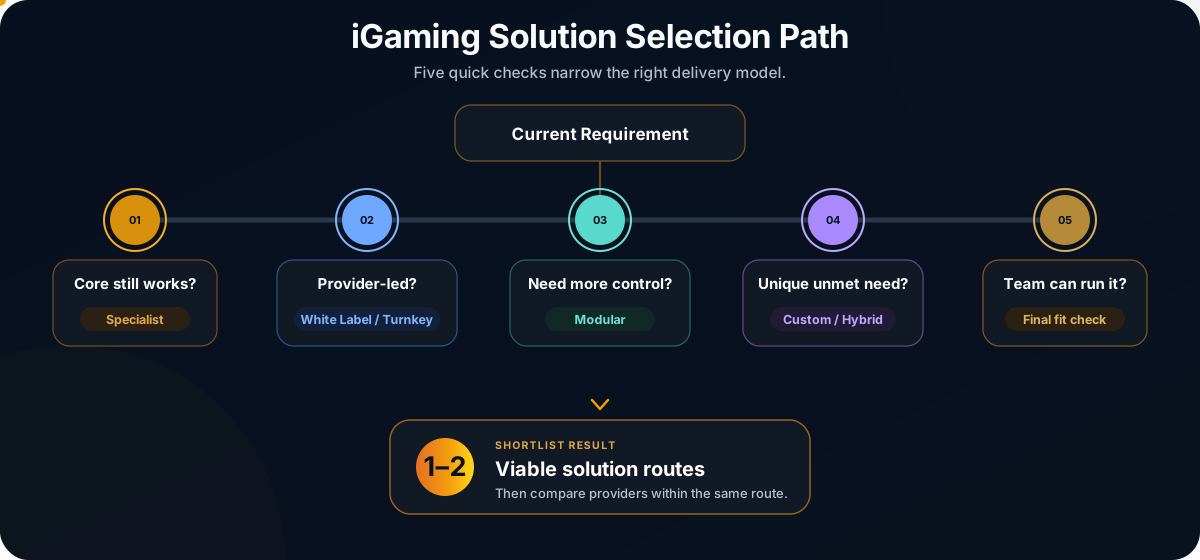
- 01Does the existing core still solve the main problem?If yes and only one capability is missing, keep a specialist product in scope instead of replacing the core unnecessarily.
- 02How much coordination should the provider carry?Provider-led delivery keeps white label or turnkey viable; greater direct control moves the shortlist toward modular routes.
- 03Is direct stack and data control essential?If yes, modular architecture becomes stronger. If not, packaged routes can remain viable.
- 04Is there a validated unsupported requirement?Custom or hybrid deserves assessment only when a real requirement cannot be met cleanly by existing products.
- 05Can the organisation actually operate the model?Remove any route that the team, available capital or next credible stage cannot support.
A disciplined selection process should finish with one or two viable solution models. Only then should provider comparison become the main task.
Turn the Route Into a Requirements-Based Provider Shortlist
Once the delivery model is narrowed, convert the decisions behind it into a formal requirements document. Capture the business objective, market, vertical, responsibility split, essential control requirements, existing systems, integrations, data needs, commercial assumptions, next growth stage and exit expectations.
- PriorityEssential, growth or optional
- OwnerInternal team responsible
- EvidenceProof the supplier must provide
- ReasonBusiness problem it solves
Replace Vague Requirements With Testable Ones
Compare providers against the same solution type and require the same operating scenarios in each demo. Examples include changing a campaign rule, investigating a failed payment, disabling content in one market or retrieving data for a migration test. This makes iGaming provider evaluation more consistent and exposes practical operation better than a generic sales demo.
Conclusion
Choosing the right iGaming solution is a filtering decision, not a feature-counting exercise. Start with the business problem, target market, operating model, required control, integrations, data access and total cost. Those decisions should remove unsuitable routes before provider comparison begins.
By shortlist stage, the operator should be comparing one or two solution models against the same requirements and real operating scenarios. The strongest option is the one that fits the team that will run it, solves the current need and leaves a realistic path for growth without creating avoidable dependency or complexity.
Frequently Asked Questions
01What Is The Difference Between An iGaming Solution And An iGaming Provider?
An iGaming solution is the technology or delivery model, such as white label, turnkey, modular, specialist, custom or hybrid. An iGaming provider is the company that supplies that solution. Define the solution type first because each model creates different control, responsibility and cost.
02Should An Operator Choose The Solution Or The Provider First?
The solution route should normally come first. Establish what is being launched, where it will operate, what the team will manage, which integrations and data access are required, and what the next realistic stage looks like. Then compare providers against the same requirement.
03Which iGaming Solution Is Suitable For A Startup?
White label or turnkey can be practical when launch speed and provider support are priorities. A modular platform becomes more suitable when the startup already has the technical capability to manage integrations, suppliers and operational data.
04What Is The Difference Between White Label And Turnkey?
Definitions vary by provider. White label generally involves more provider involvement and dependence, while turnkey usually provides a coordinated technology and implementation package with more direct operator responsibility. Confirm the exact licensing, service, data and control scope rather than relying on the label alone.
05What Creates Vendor Lock-In In An iGaming Platform?
Vendor lock-in can develop through restrictive terms, limited APIs, proprietary workflows, supplier-controlled relationships, undocumented customisations and data that cannot be exported in a migration-ready format. Evaluate exit rights and practical portability before signing.
06How Should Operators Compare The Cost Of Different iGaming Solutions?
Use total cost of ownership rather than the platform fee alone. Include implementation, commercial charges, third-party services, integrations, compliance work, internal staffing, support, data access and eventual exit or migration costs under the same assumptions.