
PAM vs CRM in iGaming explains how two systems support casino and sportsbook operations. Player Account Management (PAM) handles registration, account access, wallet records, and player restrictions. Customer Relationship Management (CRM) manages segmentation, campaigns, communication, and retention.
In this way, PAM and CRM integration connects reliable player data with targeted engagement while respecting consent and account controls. As a result, knowing each system's role helps operators avoid overlapping features and choose the right iGaming technology.
Key Takeaways
What Is the Main Difference Between PAM and CRM in iGaming?
The key difference between PAM and CRM in iGaming is their purpose. Player Account Management (PAM) maintains official player accounts, identity, access, account status, permissions, wallets, transactions, and operational controls.
By contrast, Customer Relationship Management (CRM) uses approved player data to build relationships through segmentation, marketing campaigns, communication, retention, VIP management, and lifecycle engagement.
| Feature | PAM (Player Account Management) | CRM (Customer Relationship Management) |
|---|---|---|
| Core responsibility | Owns player registration, authentication, account status, access, and operational records. | Manages player profiles, relationships, audience segments, and engagement history. |
| Payments & eligibility | Manages or connects wallets, deposits, withdrawals, transaction records, permissions, and restrictions. | Uses approved account and financial events to check eligibility and personalize engagement. |
| Segmentation & campaigns | Provides account filters and operational groups; may support basic messaging or event-triggered offers. | Builds behavioural, value-based, and lifecycle segments; manages targeted campaigns and communications. |
| Automation & reporting | Supplies approved events and controls; reports on accounts, transactions, operations, and compliance. | Runs multistep journeys across channels and reports on campaign, retention, and engagement performance. |
In practice, PAM primarily serves operations, payments, support, risk, compliance, and platform teams, while CRM supports marketing, retention, VIP, and analytics teams. CRM determines audiences, messages, channels, and timing for automated journeys using approved PAM data, but must respect consent, account restrictions, and communication permissions.
However, capabilities vary: some PAM platforms include bonuses, gamification, basic campaigns, and reporting, while some CRM platforms offer rewards and data management. Therefore, operators should compare actual features, integrations, and which system owns each data record rather than relying on vendor labels.
What Does a PAM Manage in an iGaming Platform?
A Player Account Management (PAM) system manages player accounts and core operations across iGaming casino and sportsbook platforms, directly or through connected services.
For example, PAM handles registration, login, account updates, permissions, suspension, and closure, controlling access to gaming services.
PAM or specialist providers handle identity and age checks, KYC, AML, and fraud screening. These results then guide account approval, reviews, and restrictions.
PAM or a connected wallet tracks balances, deposits, withdrawals, and transactions. However, CRM cannot change authoritative financial records.
PAM connects accounts to casino, sportsbook, payments, and bonuses, applying market, brand, currency, verification, and access rules.
In addition, PAM or connected tools enforce self-exclusion, deposit limits, cooling-off periods, and other restrictions that all systems must respect.
PAM logs account changes, transactions, access events, and staff decisions for support, record checks, investigations, and audits.
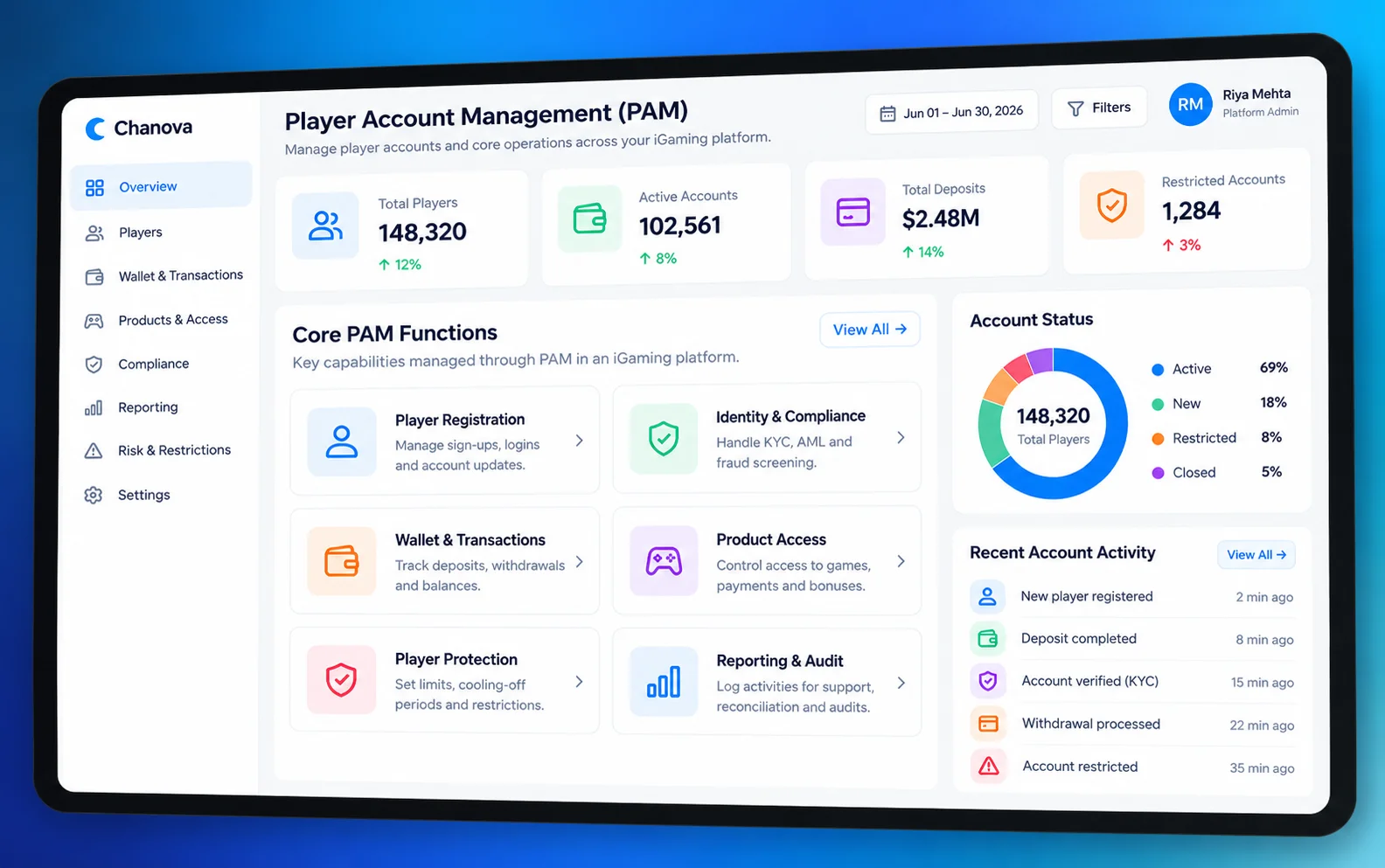
Together, these capabilities manage player access, finances, compliance, and platform operations. Importantly, PAM remains the authoritative source for account controls and financial records, even when specialist services handle wallets, verification, or player protection. As features vary by provider, check what is native, integrated, optional, or externally managed. Explore what a Player Account Management system does for more details.
What Does a CRM Manage in iGaming?
An iGaming Customer Relationship Management (CRM) platform uses approved data from PAM, casino, sportsbook, wallet, messaging, and other connected systems to manage player engagement, retention, and lifecycle communication. However, PAM retains authoritative account and financial records.
Unified player profiles
Combines approved player activity, preferences, permissions, campaign history, and player-value signals.
Dynamic player segmentation
Builds audiences by activity, inactivity, preferences, region, VIP status, and eligibility; segments update automatically as player data changes.
Campaigns and player journeys
Runs scheduled, one-off, and event-triggered campaigns and automated player journeys using player actions, eligibility checks, conditions, branches, and exit rules.
Multichannel communication
Selects eligible audiences, content, timing, and channels across email, SMS, push, and other integrations. In turn, messaging providers deliver messages and report outcomes.
Player intelligence and VIP management
Uses rules or analytics to flag changes in activity, player value, and VIP engagement so teams can assess outreach or monitoring.
CRM reporting and performance
Tracks campaign results, audience changes, journey progress, engagement, retention, and reactivation. These metrics also support performance tracking and link activity to business outcomes.
Automated player journeys follow Trigger → Wait → Condition → Branch → Action → Goal or Exit. For example, an inactivity journey can contact an eligible sportsbook player, then end or switch to another approved path when the player returns. Explore what an iGaming CRM does for more on player engagement and lifecycle management.
Where Do PAM and CRM Responsibilities Overlap?
In practice, PAM and CRM share player data in iGaming. This clear ownership helps keep operational controls and engagement aligned.
Consent and communication preferences
Consent may live in PAM, CRM, or a preference service. As a result, one authoritative source or precedence rule guides CRM permission checks before outreach.
Self-exclusion and responsible gaming
For player protection, PAM or a responsible-gaming service handles self-exclusion and restrictions. Meanwhile, CRM enforces them across campaigns, journeys, VIP outreach, and rewards.
Bonuses and rewards
CRM selects approved offers and audiences; PAM checks eligibility; a bonus engine or wallet delivers rewards. Finally, CRM records confirmed outcomes.
Player segmentation
PAM groups by account status, market, and access. CRM segments by activity, preferences, lifecycle stage, and communication history.
Gamification and engagement activities
CRM invites eligible players to missions or tournaments. Meanwhile, a gamification system tracks progress, rankings, and rewards, then shares status updates.
Reporting and analytics
PAM reports accounts and transactions; CRM reports campaigns and engagement. In turn, BI combines both using consistent metrics.
Which System Should Own Each Player Workflow?
Clear player data ownership is essential for reliable PAM and CRM integration in iGaming. PAM or connected operational providers remain authoritative for registration, login, identity verification, account status, wallet balances, deposits, withdrawals, KYC/AML and self-exclusion.
By comparison, CRM uses approved account, financial and activity events for player segmentation, consent-aware communication and engagement without replacing these source records.
| Player data or workflow | Typical primary owner | Supporting responsibility |
|---|---|---|
| Accounts, identity & compliance | PAM/core platform; identity, KYC/AML or responsible-gaming provider as applicable. | CRM uses account events and respects eligibility, suspensions and self-exclusion. |
| Wallets & payments | PAM, wallet or payment platform for balances and transactions. | CRM uses permitted deposit, withdrawal and financial signals. |
| Consent, segmentation & campaigns | CRM or central preference service for consent; CRM for segments and journeys. | PAM shares activity and eligibility; messaging providers deliver approved messages. |
| Rewards, gamification & reporting | CRM recommends offers; PAM/wallet/bonus engine settles; gamification platform runs activities. | PAM validates rewards; CRM tracks outcomes; BI combines operational and engagement reports. |
However, the exact ownership model depends on each operator's technology setup. CRM coordinates audience selection, campaign content, timing, automated journeys, bonus recommendations and invitations to missions or tournaments, while a messaging provider delivers messages and the relevant bonus or gamification system confirms delivery. PAM and connected platforms provide eligibility checks, activity events and financial outcomes; business intelligence (BI) combines PAM operational reporting with CRM engagement metrics. Therefore, define a single source of truth for player IDs, account restrictions, balances, transaction records and communication permissions, and apply consistent consent and self-exclusion rules to prevent conflicting data. See the KYC guidance, AML guidance and self-exclusion rules.
How Do PAM and CRM Work Together in iGaming?
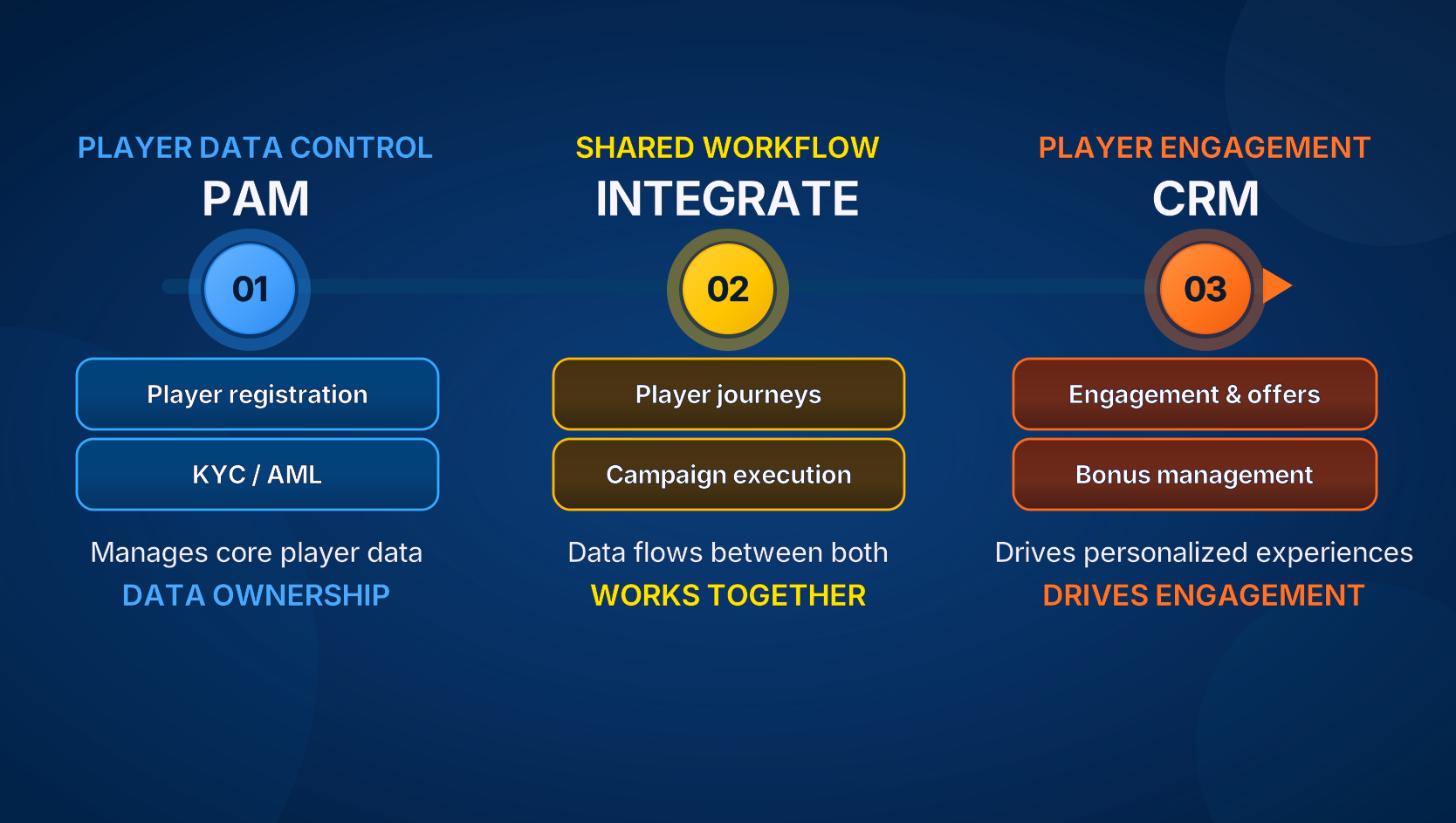
PAM and CRM integration connects trusted player activity with approved engagement. In this setup, PAM and gaming platforms retain operational records, while CRM uses permitted events for segmentation, campaigns, and automated player journeys.
PAM and CRM Integration Workflow
First, PAM records player activity and account changes, then shares approved events with CRM to update profiles and segments. Next, CRM checks consent, eligibility, self-exclusion, and communication permissions before coordinating campaigns, messages, or rewards through the relevant systems.
Finally, outcomes are tracked for reporting and reconciliation, while PAM retains ownership of account balances and financial records.
Example: PAM and CRM Integration for Sportsbook Reactivation
When a sportsbook player has not placed a qualifying bet for a defined period, PAM or the sportsbook shares activity data. Before outreach, CRM checks reactivation rules, account status, consent, suppression, self-exclusion, and permitted channels.
If the player is eligible, CRM sends an approved message through a provider. Afterward, the sportsbook records any qualifying bet, CRM stops or updates the journey, and PAM retains operational ownership.
Common PAM and CRM Integration Challenges
PAM and CRM integration can face missing or duplicate events, mismatched player IDs and permissions, outdated consent or self-exclusion data, failed messages or bonus fulfilment, conflicting market rules, and inconsistent reporting. To address these issues, clear data ownership, event validation, retries, monitoring, and reconciliation help maintain accurate, compliant player journeys.
Do iGaming Operators Need Both PAM and CRM?
Casino and sportsbook operators generally need PAM for player accounts, wallets, transactions, permissions, and safeguards, while CRM supports segmentation, automated campaigns, and retention. However, these capabilities can operate within one integrated platform or through connected specialist products.
New casino and sportsbook operators
Start with a core PAM or gaming platform for registration, account controls, payments, and compliance safeguards; add CRM when player-engagement requirements grow.
Operators with an existing PAM
Add CRM for lifecycle automation, multichannel campaigns, and reporting. Similarly, multi-brand operators should coordinate engagement across brands while respecting player permissions and restrictions.
Integrated and specialist platform operators
Integrated suites can combine PAM, CRM, bonuses, and messaging; specialist stacks offer more flexibility. In either case, both require clear data ownership, reliable integrations, and monitoring of account restrictions and financial decisions.
For operators launching without a core platform, PAM should come first to support essential gaming operations. Meanwhile, operators expanding player engagement or managing multiple brands can connect CRM to PAM for coordinated lifecycle management. Regardless of the model, integrated suites and specialist systems both require defined data ownership, reliable integration contracts, and continuous monitoring.
Ultimately, the right architecture depends on each operator’s brands, markets, operational needs, and engagement strategy, with clear responsibility for player records, permissions, and financial data.
What Should Operators Check Before Selecting PAM and CRM Systems?
When evaluating PAM vs CRM in iGaming, operators should define data ownership and a reliable source of truth for player identity, account status, wallets, consent, self-exclusion, bonuses, and communication history. For example, consistent player IDs across PAM, CRM, casino, sportsbook, and multiple brands help prevent mismatched records and support accurate player management.
Review PAM and CRM integration methods and how registration, deposits, bets, and account changes reach CRM. Also, test delayed, missing, or duplicate events, failed requests, and corrections. In addition, player-protection controls must promptly reflect consent changes, communication suppressions, self-exclusion, and account restrictions.
Then assign clear ownership of offer selection, eligibility checks, reward fulfilment, financial records, and campaign audiences, channels, schedules, exclusions, and automated journeys.
To assess operational readiness, review multi-brand separation, user permissions, approvals, audit logs, market restrictions, and consistent account, transaction, campaign, and financial reporting. Finally, review migration, third-party integrations, optional modules, support, training, responsibilities, and total costs.
Finally, request an end-to-end demonstration in which a PAM event updates a CRM profile, passes safeguard checks, triggers an approved campaign, and returns results for reporting and reconciliation.
How Gamru PAM and Chanova CRM Work Together
Gamru PAM and Chanova CRM from Pinaka.games serve complementary iGaming roles: Gamru supports player management and engagement mechanics, while Chanova coordinates CRM intelligence and lifecycle engagement. However, exact responsibilities depend on the operator's integrations.
Gamru: Player Account Management and Engagement Mechanics
Gamru PAM supports player administration and visibility alongside missions, mission bundles, progression, ranks, levels, XP, tokens, tournaments, leaderboards, and rewards. In addition, it supports direct or event-triggered campaigns through widgets and iFrames, using connected casino and sportsbook data.
Before selecting a platform, confirm whether wallet, payments, KYC, AML, and responsible-gaming functions are native or provided by integrated systems.
Explore Gamru PAM for its player-management and engagement capabilities.
Chanova: CRM Intelligence and Player Engagement
Chanova CRM uses approved PAM, casino, sportsbook, bonus, and communication data for unified profiles, dynamic segments, campaigns, automated journeys, and VIP ranking. In addition, it supports explainable player intelligence, multichannel messaging through configured providers, communication safeguards, and engagement reporting.
However, player identity, wallet, betting, and transaction records remain with their authoritative systems.
Explore Chanova CRM for lifecycle engagement and CRM automation.
Connecting Gamru and Chanova
With agreed integrations, Gamru PAM or a connected gaming platform shares approved player activity and engagement events with Chanova CRM. Next, Chanova updates player profiles, segments, and engagement context, then applies eligibility and communication rules to select suitable campaigns, automated journeys, or messages.
For example, eligible players may be invited to Gamru missions, tournaments, or reward experiences. Then Gamru manages these engagement activities and tracks approved participation, progression, and outcomes, while results flow back to connected systems to inform CRM decisions and engagement reporting.
Gamru manages engagement mechanics, while Chanova supports segmentation, CRM intelligence, lifecycle automation, communications, and VIP priorities. Meanwhile, gaming, account, wallet, and compliance systems retain their designated authoritative records.
Conclusion
For operators evaluating PAM vs CRM in iGaming, the priority is to establish clear system ownership, reliable integrations, appropriate player-protection controls, and coordinated engagement processes.
For a closer look, casino and sportsbook operators can Book a Product Demo to review how Gamru PAM and Chanova CRM may fit into their existing gaming, messaging, bonus, wallet, and reporting environment.
Frequently Asked Questions
PAM maintains authoritative player-account information and supports operational gaming processes. CRM uses approved player information for segmentation, campaigns, communication, retention and player lifecycle workflows.
No. A CRM does not independently replace core operational responsibilities such as account registration, authentication, wallet records, transaction processing and account-level safeguards.
The authoritative source depends on the operator’s architecture. PAM or a responsible-gaming system may own self-exclusion, while CRM or a central preference system may own communication preferences. CRM must respect the latest approved restrictions and permissions.
Not always. Operators generally need both account-management and player-engagement capabilities, but these can be part of one integrated platform or connected specialist systems. Clear ownership and reliable integration remain essential.
Operators should use consistent, mapped player IDs across PAM, CRM, casino, sportsbook and relevant brands. Integration rules should associate each approved event with the correct player and prevent duplicate or mismatched profiles.
Use a defined authoritative source and status-precedence rules to resolve conflicts. Where eligibility or restrictions are uncertain, CRM should withhold affected communications or offers until the latest approved account status is confirmed.
Use event validation, reliable delivery and retry mechanisms, duplicate detection, monitoring and reconciliation. Test delayed updates and corrections so CRM profiles and journeys reflect accurate player activity.
PAM or the connected gaming platform can share approved registration, login, deposit, betting and account-status events. CRM uses permitted information for profiles, segmentation and engagement while authoritative account, wallet and transaction records remain in their owning systems.